Sabrage Returns: How Circus and Cabaret Are Rewriting London’s Theatrical Rules
It is no longer enough for theatre to simply entertain. In an age where attention spans are pulled in a hundred directions, productions must surprise, immerse, and dare audiences to step into unfamiliar worlds. Enter SABRAGE, the champagne-soaked cabaret-circus hybrid that slices through convention as confidently as the blade that gives it its name. With its return to London’s Lafayette, the show offers more than spectacle. It opens a conversation about how fringe artistry, immersive ritual, and cultural decadence are reshaping what we expect from live performance.
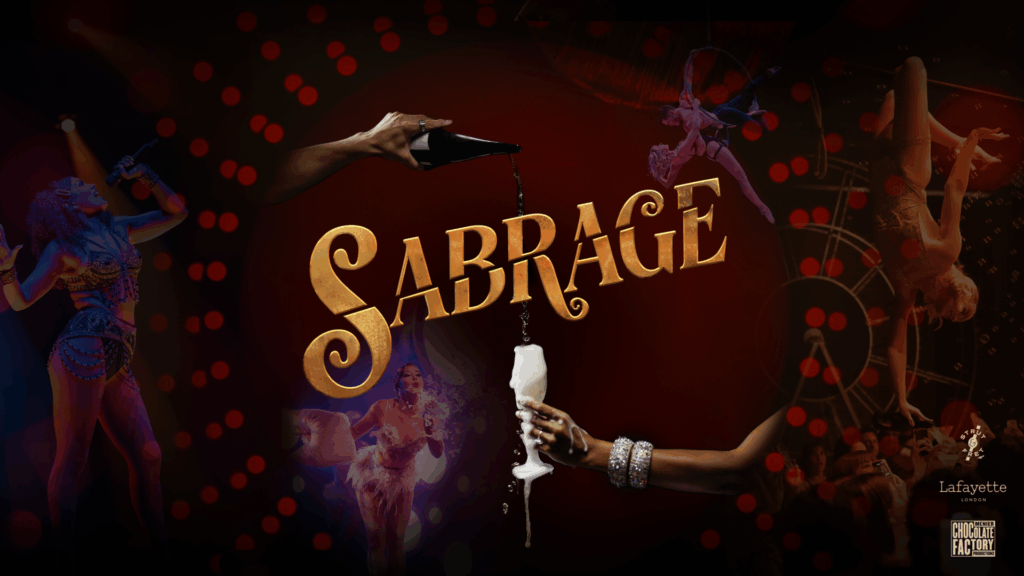
Directed by Scott Maidment and created by Strut and Fret, SABRAGE blends circus artistry with the sultry intimacy of cabaret. It is built around the ceremonial act of sabrage, the tradition of opening a champagne bottle with a sword. That image, both dangerous and celebratory, becomes the anchor for a narrative where risk and glamour dance in close embrace. Yet the show’s significance lies not only in its acrobatics or its fizz-fuelled atmosphere, but in how it reframes the conversation about what cabaret and circus can be in contemporary theatre.
Cabaret in the Age of Reinvention
Cabaret has always thrived in times of cultural tension. In Weimar Berlin, smoky nightclubs staged bold satire under the threat of censorship. In mid-century Paris, artists turned tiny basements into havens for experimental song and performance. Today, cabaret is experiencing another renaissance, this time as part of a global appetite for immersive theatre. SABRAGE taps into that hunger, placing the audience at the heart of a glittering ritual rather than asking them to simply observe from the dark.
Flynn Miller and Kimberley Bargenquast, along with a troupe including Skye Ladell, Rechelle Mansour, Remi Martin, Christian Nimri, Spencer Novich and Emma Phillips, embody a style of cabaret that is both fiercely physical and theatrically playful. Each performer slips between roles, reminding us that cabaret at its best is about transformation. Characters appear, disappear, and re-emerge in different guises, reflecting the shifting masks of celebration and excess.
Unlike the smoky clubs of old, SABRAGE situates itself in a large-scale venue while maintaining intimacy. This tension between spectacle and closeness reflects a broader trend in cabaret today. Audiences want scale, but they also crave the personal connection that television or digital entertainment cannot deliver. SABRAGE responds with a form of performance that is as much about the audience’s complicity as it is about the artists’ skill.
Circus Without the Big Top
Circus too is being rewritten. Once tethered to lions, elephants, and travelling tents, contemporary circus has transformed into something leaner, stranger, and more poetic. Companies like Circa in Australia and Les 7 Doigts in Canada have shifted the narrative towards human possibility rather than animal spectacle. SABRAGE embraces this lineage, replacing the sawdust ring with a nightclub floor, and trading spectacle for subversion.
There is danger, but it is sculpted into art. Remi Martin’s aerial sequences balance on the knife-edge between control and collapse, echoing the sabre’s razor symbolism. Acrobatics are not presented as feats of strength alone, but as metaphors for risk-taking in a world addicted to celebration. Even the act of sabrage itself, where a blade meets glass with violent precision, becomes a theatrical gesture. It is at once a flourish of wealth and a reminder of fragility.
What makes SABRAGE distinct is how it pulls circus away from family-friendly spectacle and situates it in an adult playground. This is circus as decadence, circus as indulgence, circus that winks knowingly at its own excess. In doing so, it breaks down the artificial divide between high theatre and popular entertainment.
The Ritual of Champagne and the Theatre of Excess
Champagne is more than a prop in SABRAGE. It is a character, a metaphor, and a cultural symbol. The ritual of opening a bottle with a blade has roots in Napoleonic legend, when soldiers celebrated victories with a sabre and a bottle of bubbles. That ritual is about bravado, excess, and fleeting triumph. SABRAGE harnesses those qualities and stretches them into a full-length theatrical language.
The popping cork becomes a gunshot of anticipation. The spray of fizz mimics confetti, sweat, or even tears. It is celebration, but also waste. The show confronts us with questions about indulgence. In a world facing environmental crises and political upheavals, what does it mean to stage a theatre of excess? Is it escapism, or is it critique masked in glitter?
Scott Maidment has long been interested in creating work that thrives on contradiction. With SABRAGE, he delivers a spectacle that is both joyous and unsettling, both glamorous and precarious. This duality is part of what makes the show more than a novelty act. It is theatre that reflects our cultural contradictions back at us, asking us to revel in the beauty of indulgence while recognising its dangers.
Why SABRAGE Matters Now
The return of SABRAGE to London is not merely another booking in the city’s busy theatrical calendar. It is a sign that audiences are ready to embrace forms that defy easy categorisation. The lines between cabaret, circus, musical theatre, and immersive event are increasingly blurred. Productions like SABRAGE prove that the future of theatre may lie not in polished categories but in messy, hybrid spaces where traditions collide.
There is also something distinctly timely about its theme. Champagne has always been a drink of celebration, but also one of distraction. In staging a ritual around it, SABRAGE becomes a mirror of our times. We live in an era of uncertainty, yet we still find ways to celebrate, to escape, to take risks. That tension between fragility and festivity is what gives SABRAGE its resonance beyond the nightclub walls.
A Theatrical Toast to the Future
As SABRAGE slices its way back onto the London stage, it invites us to raise a glass to theatre that is daring, hybrid, and unapologetically excessive. It is not just about circus tricks or cabaret glamour. It is about how ritual, risk, and revelry can become theatrical tools in a world that craves both escape and reflection.
Theatre, like champagne, is best when it fizzes. SABRAGE bubbles over with invention, daring us to sip, to savour, and perhaps to stumble a little as we leave the theatre. In a cultural landscape where formula too often triumphs over risk, its return is a reminder that the most memorable nights out are those where the sabre meets the glass, and the performance spills into the unknown.