Starlight Express Sets Course For World Tour After London Extension
Following confirmation that the current London revival of STARLIGHT EXPRESS is nearing the end of its run, producers have announced that the Andrew Lloyd Webber musical will embark on a world tour beginning in spring 2027.
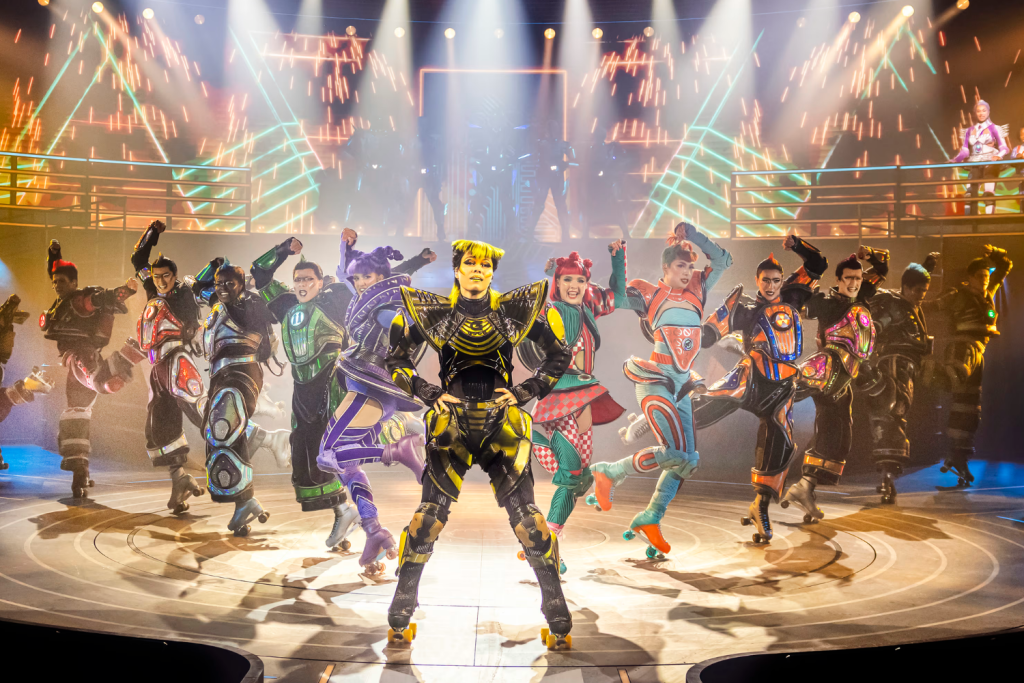
The high-octane show, famous for its roller-skating performers and stadium-style staging, centres on Rusty, a humble steam train with an outsized dream. In the story, the engines of a child’s toy world come to life and compete for glory, speed, and status. Rusty, often underestimated, longs to prove he can be the fastest engine of all, and to win the heart of the sleek first-class coach, Pearl. It is a classic underdog journey, set to propulsive music and staged with the kind of spectacle that has made Starlight Express one of musical theatre’s most recognisable titles.
Since premiering in 1984, the show has been seen by more than 30 million people worldwide, a staggering figure that speaks to its longevity and international appeal. Part pop-rock concert, part athletic event, part fairy tale, Starlight Express has long had the power to convert first-timers into fans, thanks to its sheer momentum. Even people who only know the title tend to know the vibe, bright costumes, electrifying races, and a soundtrack that moves like a train gathering speed.
The current production, directed by Luke Sheppard, plays at Troubadour Wembley Park Theatre in London. In a statement released today, producer Michael Harrison confirmed that the Wembley run will continue, and also teased the next major chapter for the production.
I’m thrilled that Starlight Express will extend for the seventh time, in the unique environment of Troubadour Wembley Park Theatre, Harrison said. “We are also thrilled that the success of this new production means we will embark on a world tour commencing in spring 2027, details of which we will announce shortly. However, for now, this is your final call for boarding to see the spectacular London revival in Wembley.
It is a line that works both as a genuine update and as showmanship. The “final call for boarding” language taps into the musical’s central imagery, and also serves as a clear prompt to audiences who have been meaning to book. While the production has been extended multiple times, Harrison’s wording makes it clear that the Wembley chapter has an endpoint, even as the production prepares to travel.
Troubadour Wembley Park Theatre is not a traditional proscenium house, and Starlight Express thrives in spaces that feel more like arenas than sitting rooms. The musical’s design has always favoured immersion and proximity, with performers sweeping through the space at speed, and audiences positioned to feel the action rather than simply watch it. In a production like this, the theatre is not just where the show happens, it is part of the show’s engine.
The creative team behind the London revival is stacked with major names across direction, design, and music. Alongside Sheppard, the production features set design by Tim Hatley, costume design by Gabriella Slade, lighting design by Howard Hudson, sound design by Gareth Owen, and video design by Andrzej Goulding. New orchestrations come from Matthew Brind in collaboration with Andrew Lloyd Webber, with musical supervision by Brind and David Wilson. Musical direction is by Denise Crowley, and casting is by Pearson Casting.
That list matters, because STARLIGHT EXPRESS is not a show that succeeds on charm alone. It demands precision across departments. Costumes need to communicate character instantly, while still allowing athletic movement. Lighting and sound must support speed and spectacle without tipping into chaos. Video and set elements must enhance the sense of competition and scale, while keeping the storytelling clear. Above all, the music has to do what trains do, build momentum, maintain rhythm, and make you feel the pull forward.
The announcement of a world tour starting in spring 2027 positions this production as more than a limited London revival. It suggests a strategy, refine the show in Wembley, prove its box office strength, and then export a version of Starlight Express that is already tested, acclaimed, and tuned to contemporary audiences. In a touring market where recognisable titles can still dominate, Starlight Express offers something increasingly rare, a musical that is not just beloved, but also visually distinctive in a way that is easy to market. Even in a crowded calendar, it is hard to confuse it with anything else.
For now, specific tour stops, casting information, and timelines beyond the “spring 2027” launch window have not been announced. Producers have said that details will follow “shortly” and that more information is expected “in due course.” That may include which territories the tour will prioritise, whether the production will mirror the Wembley staging exactly, and how the show will adapt to different venues internationally.
What is clear is that the London run, while extended again, is being framed as finite. For audiences in the UK, that makes the current revival a now-or-never ticket, a chance to catch a version of the show that is collecting awards, packing houses, and about to become the template for a global tour.
And for the wider world, the announcement signals a new moment for one of musical theatre’s most kinetic productions. Rusty’s dream has always been about speed, belief, and proving the doubters wrong. Now, that dream is leaving the station again, with Wembley as the departure point, and a world tour on the tracks ahead.