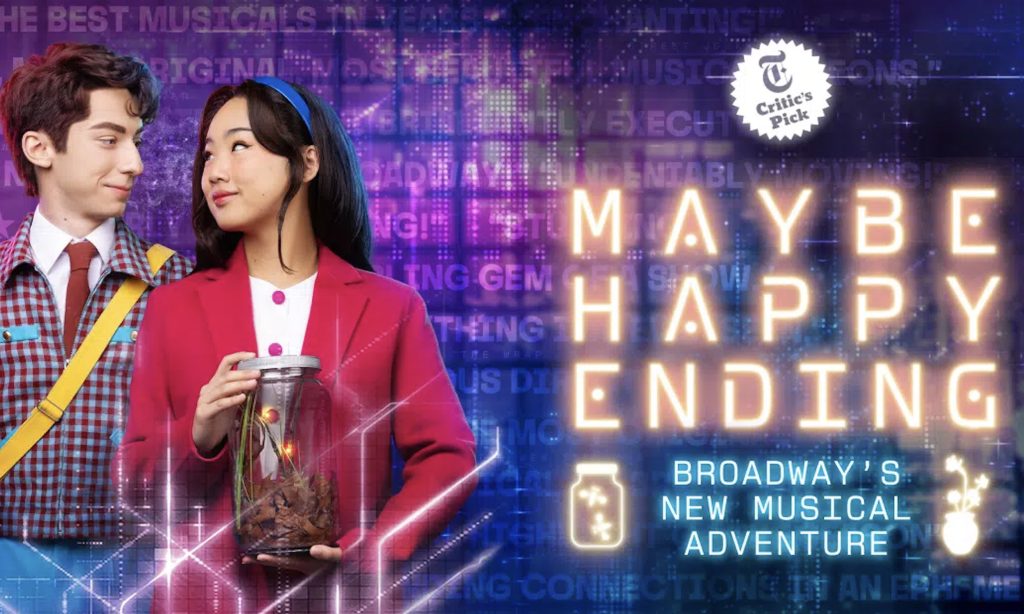
Maybe Happy Ending, a tender robot romance, is Broadway’s most human new musical
Broadway has a new frontrunner for the season’s hottest ticket, and it is a love story between two retired helperbots. At the Belasco Theatre, booking through 25 May 2025, Maybe Happy Ending unfolds with an intimacy that sneaks up on you, then blossoms into something grand and deeply felt. Set on the outskirts of Seoul in 2064, the musical pairs luminous performances by Darren Criss as Oliver and Helen J Shen as Claire with a creative team that treats science fiction with a poet’s touch.
Director Michael Arden steers the production with restraint and precision. The result is a show that whispers rather than shouts, yet resonates long after the curtain call. Will Aronson and Hue Park supply book, music, and lyrics, weaving a score that moves from cozy apartment reveries to road trip rushes to late night jazz memory, always in service of character. Numbers like World Within My Room and The Way It Has to Be sketch the boxed in routines of two machines left behind by their owners. As Oliver and Claire venture out, songs such as Hitting the Road, How Not to Be Alone, When You Are in Love, and the title tune widen the horizon, musically and emotionally.
Visually, the production is a marvel. Dane Laffrey’s shape shifting environment and Ben Stanton’s precise lighting turn the Belasco into a kinetic jewel box. Rooms slide and recede, city grids glow, and quiet countrysides open like a breath. George Reeve’s video design layers in flickers of stored memories, letting the past flare across the present with a touch that feels both intimate and cinematic. The design never overpowers the story, it frames it with elegance and clarity.
Criss crafts Oliver with meticulous physical detail, fusing buttoned up neurosis with boyish warmth. Shen’s Claire counters with spark and self possession, a presence that reads more human even as the character insists on her circuitry. Their chemistry is the axis on which the evening turns, curious at first, then magnetic, then complicated by the kinds of choices that make hearts race and logic crumble. Marcus Choi adds a thread of generational ache as both James and Junseo, a father and son whose history with Oliver gives the adventure texture and stakes. Dez Duron’s onstage jazz singer, Gil Brentley, glides through the evening as a stylish conduit to Oliver’s cherished playlists, reminding us that the sound of a life can be as defining as the facts of it.
The show’s premise is simple. Two obsolete robots meet, share resources, and begin to need one another in ways they were not programmed to understand. From that seed, the story grows into a meditation on memory, care, consent, and connection. The pandemic era hangs in the background as subtext, not as theme, a quiet acknowledgement of how dislocation can rewire the rhythms of a life. Maybe Happy Ending never leans on spectacle for its own sake. Its surprises arrive as character turns, as visual apertures opening and closing, as melodies that catch in the throat.
Aronson and Park’s writing resists easy sentiment. The arc is full of mischief and wit, then lands with a finale that is clever, wry, and earned. The title makes a promise and keeps it, though not in the way you might expect. By the end, the robots feel less like a conceit and more like a mirror. The show suggests that love is a practice, not a program, and that the work of becoming known, to oneself and to another, is the most human code of all.
Broadway gets many new musicals each season. Few arrive this fully formed. Maybe Happy Ending is beautiful to look at, beautiful to hear, and even more beautiful to sit with after you leave the theatre. It is gentle, funny, and disarmingly profound. If there is justice in the world, this will be the musical everyone is talking about.