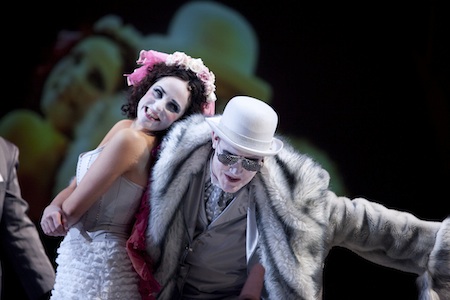
The Threepenny Opera can on its surface seem inaccessible. Bertolt Brecht wrote to challenge his audience and political satire can be difficult to parse, but if you know the standard Mack The Knife (think Bobby Darin, Ella Fitzgerald, Blake Lewis from American Idol Season Six… is that one just me?) you have already in your head the basic, if somewhat toothless, idea of what The Threepenny Opera is all about.
Mack the Knife – Macheath— is the villain-slash-hero-slash-anti-hero of the piece, a smooth and suave but completely impulse, driven serial killer. He terrorises his underworld with a flick knife, a motley band of criminals, and childhood connections to the police chief, seemingly untouchable until he marries the daughter of the King of the Beggars (he’ll tell you where you stand and which arresting religious quotes to write on your placard). Soon, he’s condemned to hang – but that’s not the point. The point is the journey.
In fact, the journey is so much the point that the writers themselves do away with much development concerning the plot. Macheath is saved from his hanging fate with a hastily constructed deus ex-machina and no one seems, at any stage, to have learned anything. It’s not the characters, after all, who are driven by impulse, and hedonism, and greed and lust and jealousy. There is not a hint of conscience within most of these characters, which is appealing in its absence of morality. It’s in that absence that the show finds its own conscience. Brecht, through director Michael Kantor, holds a mirror, unflinching, to our society, and Weill, through Gill, has scored it with acerbic alacrity. With no moral agenda in the world of the opera, we are forced to create our own. That is a powerful dramatic gift from creators to audience.
There is no fault to be found with the performance in the production. Eddie Perfect – who is an extraordinarily committed Mack, with his menace and command of the stage – and the strangely, beautifully strong-yet-vulnerable Paul Capsis lead a compelling and mesmerizingly complex mix of characters. Amanda Muggleton and Grant Smith are lewd, argumentative, and hilarious as the Peachums, Luke Joslin proves himself once more as one of the rising stars of Australian theatre with his remarkable physical comedy, and Lucy Maunder’s vocals, in particular, evoke a sweetness and purity that weave a sense of lost innocence into the goings-on around her.
It’s fitting that Mack the Knife has evolved into a gentler, toe-tappier standard because the Threepenny Opera, written by Bertolt Brecht and Kurt Weill in 1928, was actually born from 1728’s The Beggar’s Opera, created by John Gay. The conceit has been produced multiple times, most recently on Broadway in 2006, but it sees a whole new life here, thanks in large part to Richard Gill’s capable conducting hands. We think of jazz halls, we think of Chicago, and Cabaret; the Threepenny Opera is hugely important to musical history, directly influencing musical theatre from the thirties and onwards.
Brecht’s interpretation, written in a rising Weimar republic, was set in Victorian London, though this staging has chosen to set it in some kind of anachronistic old-time-y Sydney. I don’t think that moving the play somewhere into the vicinity of Channel Nine’s Underbellyseries did anything for the story; if anything the play seemed to be mocking its characters by having them be from Redfern and Double Bay. The local shift of the production made it all seem a little more heavily sharp, and cruel – as an audience, we don’t have to do all the work ourselves in really thinking about what it means to be confronted with a world so bad, because programming like Underbelly has already distanced us from the concept of gangster ‘bad’. It’s harder to see the reflection of their darker sides and looser morals in ourselves.
It’s an interesting deviation from Brecht’s theatrical design, his way of encouraging an audience to think about what, truly, is unfolding before them. But then – maybe transporting the original Beggar’s Opera, a world devoured by greed and sex and violence to a world currently devoured by mass market Australian television made up of greed and sex and violence says it all.
Book online at sydneytheatre.com.au
Until 24 September 2011
Music icon Sting will return to the stage in a newly adapted production of his…
Broadway’s biggest night is fast approaching, with the Tony Awards set to celebrate another busy…
The Genesian Theatre Company is proud to present a moving new production of Harper Lee’s…
Minister for Sport and Major Events Steve Dimopoulos, together with producers Tony Cochrane AM and…
Liverpool City Council’s much-loved celebration of Asian culture and cuisine, Lanterns and Lights, returns on…
The Australian Premiere of the smash-hit Broadway musical Tootsie, officially opens at Teatro at the…