
MTC: Ghosts
Overwrought and underwhelming, the MTC’s Ghosts is as haunting as the Luna Park ghost train, but not as fun.
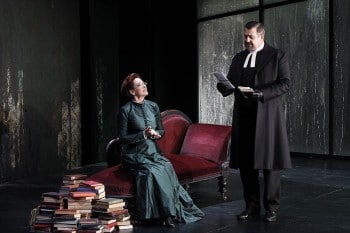
The 1880s critics generally despised Henrik Ibsen’s play for being a pit of degenerate ickiness that dared to talk about nice middle class people knowing about syphilis, sex and incest.
Widowed 40-something Helene Alving (Linda Cropper) is thrilled to have her 20-something son, Oswald (Ben Pfeiffer), back home from Paris, and is excited that her old crush, Pastor Manders (Philip Quast), is visiting to bless and open the orphanage she built in honour of her late husband. Meanwhile her maid, Regina (Pip Edwards), is leaning français to impress Oswald and Regina’s dad, Jacob (Richard Piper), wants Regina to work at his new house for wandering seamen.
Gale Edwards’s translation so simplifies (and Aussifies) the script that the seamen pun is a highlight in a tale that now states the obvious, explains it a bit more and yells it again. And it’s directed by Edwards to focus on that translated script.
In performances described to me as “a bit shouty” (I said over played and under felt, but shouty is better), it relies on its words to tell the story. Words tell a story in a novel, on a stage they are the base to start from.
To find the emotional connection with the world and its characters, there has to be a belief and understanding on the stage that sex outside of a good-god sanctified marriage is unforgivable. Unless we can understand and feel that, all that’s left is a “so what?”. Even the final scene between breaking mother and broken son are close to dull because there was no relationship in the space between the actors.
At least Shaun Gurton’s striking design of rain and fog creates some mood and sense of place with Paul Jackson’s lighting.
Perhaps the 1880s critics might have liked it.

We can keep palming off responsibility to Gale Edwards as much as we want, but as a critic, claiming it’s entirely the directors fault is the easy way out, and all of you are doing it.
The problem with this production lies as much in whoever the fuck keeps casting these MTC things as it does the direction. The actor playing Oswald brought the pieces climax to a level of ham so extravagant a Rabbi would be reduced to tears.
A play is the sum of it’s parts, and bad casting (and dare I say bad acting) is the part that is so often left out of all of you journalist’s reviews (from what, fear of offending the actors?).
Yes I’m pissed off.
Linda Cropper was wonderful by the way.
I’m the actor who played Oswald in this production.
Reading this 12 years later, I’m going to push back on the way you’ve reduced the performance to “ham” and “bad acting.” That’s not insight – it’s a simplification of something you don’t have full visibility on.
What you saw on stage was the execution of a very specific, deliberately heightened, melodramatic directorial vision. As actors, we’re engaged to realise that vision – not override it because it might read better from the outside.
What you didn’t see was the process.
That production was one of the most damaging professional experiences of my career. The working environment was, at times, deeply unsafe, and the cast were operating under sustained pressure that no audience member would have been aware of. It took me years to recover. I struggled with crippling stage fright for years after and very nearly walked away from acting altogether.
This production didn’t just come and go – it contributed to the introduction of far stricter anti-bullying policies within the company. That should give you some sense of what was happening behind the scenes.
It was also my first mainstage role. I didn’t feel safe or empowered enough to speak up at the time.
So yes – have an opinion. Critique the work.
But before you dismiss a performance in those terms, understand what you’re actually looking at – and consider the reality that actors are human beings working within systems you’re not privy to.
And maybe think twice before delivering that kind of judgment from behind a blank profile