
EVITA Reborn: How a Populist Icon Found New Power at the Palladium
In a year teeming with revivals, reconceptualisations, and reimaginings, few announcements stirred the theatrical pot quite like the London Palladium’s upcoming staging of EVITA. With Rachel Zegler stepping into the iconic stilettos of Eva Perón, this limited engagement has sparked both nostalgia and renewed curiosity. But beyond the dazzling press releases and viral trailers lies a more intriguing question: why does EVITA keep returning, and what makes it feel so right now?
This isn’t just a star vehicle or a tribute to a classic score. It’s a mirror held up to power, image, and womanhood. And the Palladium’s 2025 production is shaping up to offer far more than the sum of its parts.
Don’t Cry for Me, But Look Closer This Time
From the moment EVITA premiered in the late 1970s, the musical has courted controversy and captivation in equal measure. The score, by Andrew Lloyd Webber and Tim Rice, gave us soaring ballads like Don’t Cry For Me Argentina and You Must Love Me, but also provoked questions about glamorising authoritarian figures. Is Eva Perón a saintly saviour, an ambitious manipulator, or something in between?
“I think that ambiguity is what makes it timeless,” says director Jamie Lloyd, who helms this stripped-back, stylised production. “We’re not here to sanctify or demonise. We’re here to listen, to challenge, and to hold the tension.”
That tension is palpable in the casting of Rachel Zegler, a rising star whose own cultural heritage and Gen Z sensibility bring a fresh energy to Eva. Zegler’s breakout role in WEST SIDE STORY showcased not only her vocal power but a rare emotional precision, and early footage from the EVITA trailer suggests she’s leaning into the contradictions of the role with fearless intent.
Her performance doesn’t chase Patti LuPone’s ghost nor mimic Madonna’s film portrayal. Instead, she reclaims Eva as a woman born of her era but understood through ours, navigating class, gender, and performance in a patriarchal society with only charisma and couture as weapons.
A Pop Concert for the People’s Saint
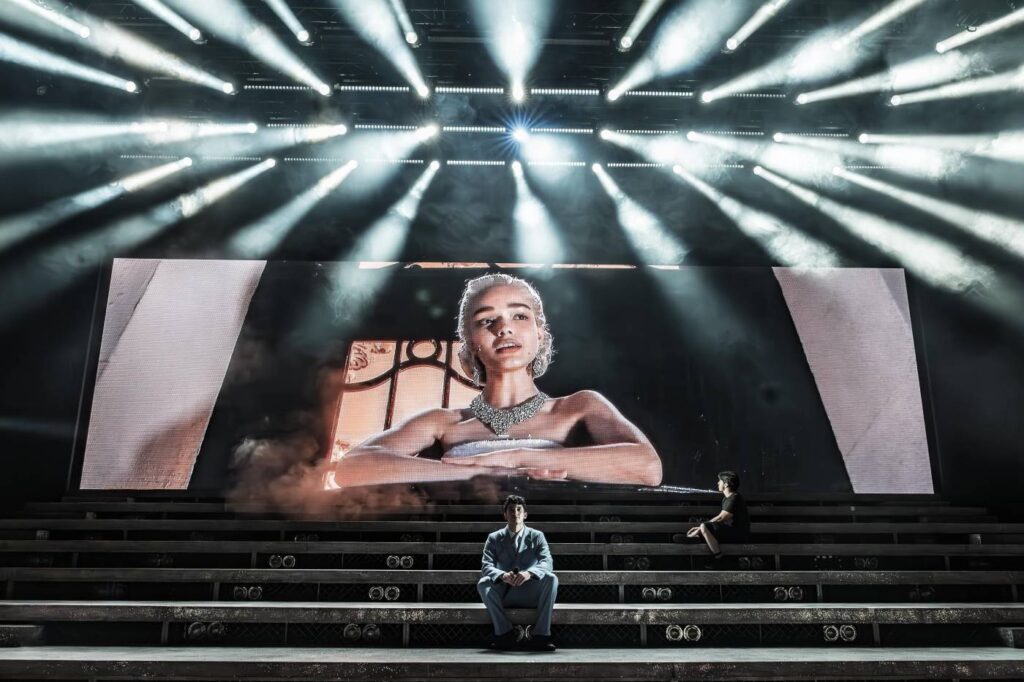
Perhaps the most fascinating, and overlooked, aspect of EVITA’s current revival is how it plays with the idea of spectacle itself. The Palladium staging is being billed almost like a rock concert. There’s a rotating stage. A video wall. Stylised costumes that reference high fashion and political theatre in equal measure. But it’s not spectacle for spectacle’s sake. “Eva knew how to use the crowd,” notes movement director Arlene Phillips, in a behind-the-scenes clip. “She understood image better than most politicians ever could. And that’s what we’re leaning into, not just her story, but her staging of herself.”
This approach is more than aesthetic. It cleverly positions EVITA within today’s media circus of curated personas, Instagram activism, and political theatre. From influencers to politicians, the line between authenticity and artifice is increasingly blurred, a dynamic Eva arguably anticipated half a century ago.
This isn’t lost on the creative team, who have infused the production with multimedia design that echoes political rallies and pop star arena tours. At times, the show feels like it could sit comfortably alongside a Taylor Swift Eras Tour or a Beyoncé Renaissance concert. But while those icons sing about heartbreak and empowerment, Eva sings about legacy, illness, and mortality.
It’s a dazzling juxtaposition. And it asks us: who gets to control their narrative, and at what cost?
The Power of a Woman’s Voice, and Who Gets to Hear It
There’s another layer to this EVITA that feels especially relevant in 2025, its exploration of the gendered politics of voice. In musical theatre, female characters are often celebrated for their vocal extremes, but rarely given narrative control. EVITA is a rare exception. Eva speaks, sings, seduces, shouts, and sobs, and the world listens.
This new production doesn’t mute her contradictions. Instead, it highlights them. Early reviews from workshop stagings hint at a more intimate You Must Love Me, delivered not as a plea for affection, but as a pointed demand for recognition. And Buenos Aires reportedly crackles with modern urgency, reframing Eva’s arrival in the capital as a moment of reinvention not unlike a viral social media rebrand.
Perhaps the boldest directorial decision, however, lies in the treatment of Che, traditionally the cynical narrator who challenges Eva’s myth. In this version, Che is less a literal character and more an embodiment of public scrutiny, a composite of the media, the masses, and internalised doubt. This fluidity sharpens the show’s edge, turning it into less of a historical pageant and more of a psychological unravelling.
The Revival We Didn’t Know We Needed
While countless revivals this decade have banked on audience nostalgia, the Palladium’s EVITA feels more like a reckoning than a celebration. It challenges our assumptions, about politics, about performance, and about the roles women play on and off the stage. It also challenges our understanding of what a revival should do. Rather than lovingly dusting off a beloved artefact, this production excavates something raw and unresolved from within it. As Rachel Zegler recently told commented, “There’s a reason EVITA keeps coming back. She’s not done speaking.” Neither is theatre. And in this new EVITA, the conversation is louder, sharper, and more necessary than ever.