
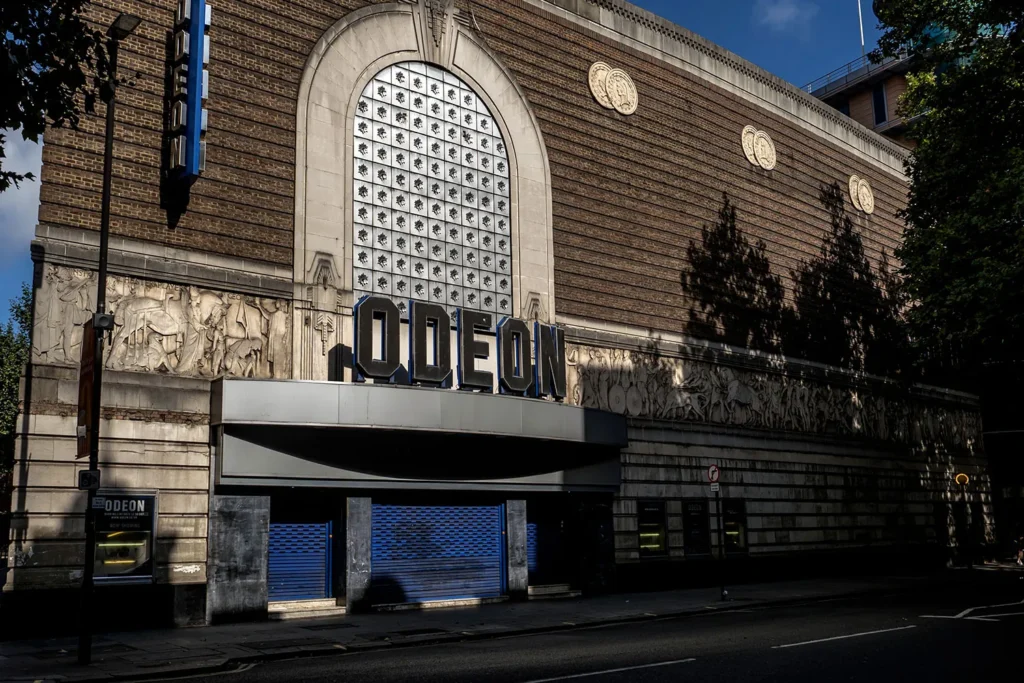
Are We Losing a West End Gem?
For anyone invested in the future of live performance, or even just in preserving London’s theatrical heritage, the Saville stands as a bridge between eras. Built in the 1930s, this Grade-II listed venue witnessed countless classic productions before branching out to host the likes of The Rolling Stones, Chuck Berry, The Who, and Jimi Hendrix. Picture that—four icons of modern music belting out rock anthems on a stage once dedicated to more traditional fare. It’s a testament to London’s ever-evolving entertainment scene: a theatre that can morph with the times yet remain a space for artistic innovation.
But if you stroll by today, you’d see an Odeon cinema. Perhaps you’d wander inside to catch the latest blockbuster, not realising that below that screen lies the spiritual residue of decades of enthralling performances. It’s precisely this dynamic history that has made the Saville a target for modern redevelopment. In 2021, Yoo Capital purchased the site and promptly announced a partnership with CIRQUE DU SOLEIL ENTERTAINMENT GROUP, with the aim of transforming the cinema into the company’s first permanent UK home. Talk about raising eyebrows! The West End is no stranger to spectacle, but Cirque du Soleil? That’s an entirely different calibre of big top grandeur.
What the New Plans Entail
In March 2024, a set of ambitious proposals emerged. The blueprint was simple enough on paper: reintroduce a live performance venue while also incorporating a boutique hotel in the upper floors. The ambition was—and remains—enormous. Under these plans, the existing building would be partly demolished, partly retained, and then stabilised for refurbishment. A brand-new basement would be excavated to house the performance venue. On street level, there’d be retail spots, a slick theatre lobby, a box office, and front-of-house facilities. Upstairs, you’d find a sleek new hotel, complete with a six-storey extension atop the original structure.
Critics, conservationists, and theatre buffs alike had plenty to say about this. Some folks lauded the idea of breathing new life into a historical site. Others were more circumspect, worried about the ‘Frankenstein effect’—bolting together modern architecture and commercial aims with a cherished, decades-old building.
In February 2025, the scheme was updated. After ongoing talks with London Borough of Camden (LBC), the Greater London Authority (GLA), Historic England, and Theatres Trust, Yoo Capital altered the plans to reduce the building’s proposed height by a little over eight metres. So, a chunk of the towering extension was effectively lopped off. In theory, that should have mollified the preservationists. Right?
A Storm Of Objections
Not quite. Historic England remains unconvinced that the new design addresses fundamental issues. They argue that sinking the auditorium entirely underground effectively strips the Saville of any meaningful connection to its original theatre space. In their letters, they point out how the basement depth has gone from 17.4 metres in the initial proposal to 21.8 metres in the latest iteration—far deeper than the existing 7.8 metres. That means the new stage and auditorium would no longer inhabit the same vertical plane as the old one. If you’re a heritage purist, that’s akin to taking Shakespeare’s Globe off the ground in Southwark and building it on top of a skyscraper in Canary Wharf. The soul of the place, they believe, would be severed from its historic context.
They’re also sounding alarms about “Regent’s Street Disease,” a catch-all term for structural and material issues (often linked to steel beams corroding within older buildings). Their worry is that the full extent of the building’s weaknesses hasn’t been thoroughly assessed, which could lead to bigger costs, more invasive construction, or even partial demolitions once the refurbishment is underway. In short, from a preservation standpoint, there’s too much uncertainty.
Enter The Theatres Trust
When the Theatres Trust issues a statement, theatre lovers listen. They’re not known for knee-jerk reactions, and they’ve long championed the idea of reviving the Saville as a working theatre. So when their CEO, Joshua McTaggart, publicly slammed the new proposal, it was akin to a clarion call for anyone invested in the West End’s cultural vitality. In his view, relocating the auditorium deep below ground compromises the building’s integrity. More crucially, it reduces capacity. The Theatres Trust believes an 800-1,000 seat theatre would be a far better commercial and cultural proposition than a small-scale venue overshadowed by a hotel. After all, adding new hotels to the West End might bring in revenue, but at what cost to London’s theatrical tapestry?
McTaggart doesn’t mince his words. He mentions that “if the scheme goes ahead in its current form, it is a missed opportunity.” This echoes the sentiments of many who see the Saville not merely as another piece of real estate but as a rare slice of history that, if cultivated properly, could be a shining star for theatre revival—particularly given how West End audiences and London tourists consistently fill the city’s venues, generating billions in revenue.
A Data Snapshot
For a bit of perspective, consider this: according to the Society of London Theatre, over 15 million people attended West End shows in a recent pre-pandemic year, generating a box-office revenue north of £765 million. That’s not just a statistic; it’s a clarion indicator that London’s appetite for theatre remains voracious. Venues that maintain historical charm while offering modern comforts are especially beloved. Why, then, risk alienating a proven market by burying a theatre auditorium far beneath the ground?
Moreover, new data suggests heritage-led regeneration can boost local economies by up to £1.60 for every pound invested, especially if the building in question is already an architectural or cultural landmark. In that sense, the Saville’s conversion into a fully modern theatre—paired with smaller, more sympathetic commercial elements—might yield long-term returns for both investors and the city’s cultural scene.
Balancing Commerce And Culture
One angle often overlooked in these discussions is the balancing act between private investment interests and cultural preservation. Sure, Yoo Capital wants to capitalise on the Saville’s prime location, and a boutique hotel in the West End is undoubtedly appealing to many travellers. But if the cost is effectively gutting the heritage out of a theatre that once hosted The Rolling Stones—the mind reels at the thought. Perhaps a more imaginative design could retain the theatre’s original footprint while cleverly integrating hotel floors above. Some critics argue that the developers should look to other heritage-led theatre refurbishments in the UK, such as Battersea Arts Centre or the Alexandra Palace Theatre, for evidence that the best solutions often lie in creative compromise.
Also, there’s the question of whether CIRQUE DU SOLEIL ENTERTAINMENT GROUP would truly be best served by a subterranean space with a presumably lower capacity. The group’s calling card is spectacle on a grand scale, and for that, you need height, breadth, and a sense of wonder in the architecture itself. To squash that potential in a cramped underground shell might undermine the promise of a permanent UK home.
What the Future May Hold
Both Historic England and the Theatres Trust have signalled they’re not opposed to the concept of restoring the Saville to a live performance venue. Far from it. The main contention is how it’s being done. Could there be more nuanced solutions that preserve the building’s character while still enabling modern functionality? The conversation is ongoing, and further announcements are expected soon.
From an industry perspective, there’s also a growing chorus of producers and theatre operators who would leap at the chance to manage a mid-sized West End venue. Amid talk of a possible theatre shortage—especially for mid-scale productions looking to scale up from off-West End spaces—an 800-1,000 seater in the heart of London could be a goldmine. So McTaggart’s assertion that a “dedicated theatre scheme with larger-scale offer” might be more beneficial to the community isn’t just romantic pining for the glory days. It’s a genuine business argument.
As someone who first discovered the Saville Theatre almost by accident, I can’t help feeling that its fate mirrors the larger tension in modern urban development: do we prioritise short-term gains or invest in the cultural mosaic that makes our cities enchanting in the first place? The West End isn’t merely about lights and ticket sales; it’s a living museum of performance history. The very walls of these theatres whisper stories of breakthroughs, innovations, and sensational nights that shaped our cultural lexicon.
If the Saville is to thrive again, it must do so in a way that respects its heritage while embracing contemporary possibilities. And if the current plans fail to hit that mark, maybe the time has come for everyone—developers, local authorities, conservationists, and theatre lovers alike—to revisit their assumptions. After all, we lose more than an old building when we disregard its past; we lose a living testament to the city’s perpetual reinvention through art.
A missed opportunity, indeed. Let’s hope the next chapter for the Saville sets the stage for something that truly honours its storied history—while giving future generations a new reason to marvel on Shaftesbury Avenue. Because the West End, at its best, isn’t just about real estate; it’s about real magic.

