
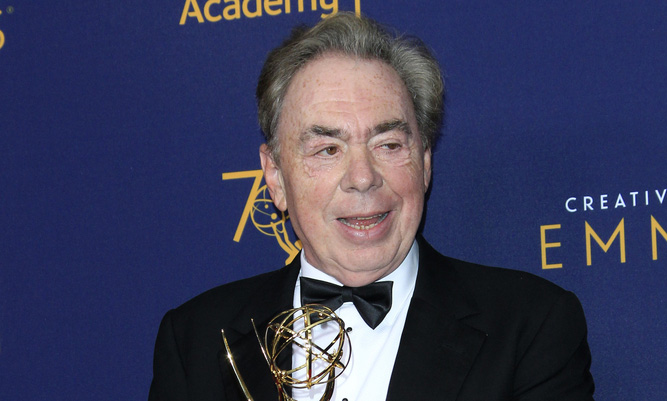
Andrew Lloyd Webber: The Billionaire Composer Who Refuses to Bet on Himself
By any measure, Andrew Lloyd Webber has nothing left to prove. The British composer who gave the world The Phantom of the Opera, Cats, Evita, and Sunset Boulevard has built one of the most successful careers in entertainment history. Yet at 77, he is still writing, reinventing, and refusing to rest on his laurels. His shows continue to fill theatres worldwide, his fortune exceeds a billion dollars, and his creative energy remains undimmed. But as he enters a new chapter, Lloyd Webber is rethinking not just his work, but his entire relationship with the business of theatre.
A Second Act for the Master of Musicals
Lloyd Webber is, in many ways, reliving his own Sunset Boulevard moment: ready for his close-up, again. The 1994 musical adaptation of the classic film just returned to Broadway in a Tony Award-winning revival starring Nicole Scherzinger. A reimagined version of Cats—Cats: The Jellicle Ball—is already slated for Broadway in 2026. Even The Phantom of the Opera, which closed its record-breaking Broadway run in 2023, is being reborn as Masquerade, an immersive off-Broadway experience that allows audiences to walk through the world of the Phantom himself.
“I’ve always wanted to break new boundaries,” Lloyd Webber says. “To have new directors looking at work, thinking of different ways of doing it. It’s a continuation of what I’ve always liked to do. And of course, I haven’t given up writing.”
Reinvention Behind the Curtain
Part of this creative resurgence stems from a major overhaul of his business empire. The Really Useful Group, long the licensing and production engine of his global theatrical portfolio, has been reborn as LW Entertainment under the leadership of James McKnight, known for his work with J.K. Rowling’s Harry Potter franchise. The mission is ambitious: to turn Lloyd Webber’s brand into a modern entertainment powerhouse spanning theatre, film, gaming, and consumer products.
“I decided to go back to being a composer again,” he says. “It was a decision I took about two years ago, and I think it’s proved to be the right one. We’ve got completely new management, new people. The whole thing is running in a totally different way.”
That shift also includes a new producing partnership with veteran impresario Michael Harrison, whose collaboration with Lloyd Webber has already yielded the acclaimed Sunset Boulevard revival and a buzzy new Evita on London’s West End. Together, they are shaping a model that fuses creativity with commercial savvy, balancing artistic control with delegation—something Lloyd Webber has come to value more than ever.
The Phantom Goes Immersive
Of all his recent ventures, Masquerade may be the boldest. Inspired by the long-running immersive hit Sleep No More, the production reimagines Phantom as a close-up, multi-sensory experience in which audiences wander through the story. “I wondered whether it would be possible with a musical,” Lloyd Webber explains. “And I spoke to Randy Weiner and Diane Paulus, who produced Sleep No More, and Diane said, ‘Well, why don’t we do it?’”
The result is a deeply personal theatrical experiment. “You’re hearing singers live, closer than I am to this cup here,” he says, gesturing toward the coffee on the table beside him. “It’s a completely new experience. When [the heroine] Christine sang Twisted Every Way in a tiny room, it was the most extraordinary moment I think I have had in my career.”
The High Cost of Broadway Dreams
But Lloyd Webber is clear-eyed about the industry that made him a global icon. With production costs on Broadway often exceeding $20 million, he admits that the future for new musicals is uncertain. “It’s going to be very difficult for people to really produce major new work on Broadway now,” he says. “The costs of production are just cripplingly high. I find this all very, very sad.”
Even as audiences return post-pandemic, attendance remains below pre-2020 levels. For Lloyd Webber, Broadway has always represented the pinnacle of theatrical ambition, but the economics of mounting new shows are increasingly untenable. It’s a reality that might have crushed a less seasoned artist—but for him, it’s motivation to evolve.
The Lesson of Cats: Risk and Reward
Lloyd Webber’s appetite for risk is legendary, though he’s quick to admit it hasn’t always been prudent. “The biggest [risk] was Cats in London,” he recalls. “Nobody thought it could remotely be a success.” He mortgaged his home to fund it, betting everything on a musical based on T.S. Eliot’s poems, performed by dancers dressed as felines. “If it had been a disaster, I’d have lost my house,” he says. The gamble paid off spectacularly, making Cats one of the longest-running and most profitable musicals in history.
Yet for all his financial success, Lloyd Webber maintains a surprising rule: he never invests in his own shows. “Never really to invest in your own shows,” he says firmly. “I don’t think one should.” Why? “Because you need somebody to say, ‘No, that’s wrong.’” For him, creative distance and financial independence are essential to maintaining integrity—and sanity.
The Man Behind the Music
Offstage, Lloyd Webber’s passions are quieter but no less intense. “My great love, other than theatre, has always been architecture,” he says. “An ideal day is going somewhere and just looking at buildings.” He also confesses to an enduring affection for the Pre-Raphaelite art movement. “I suppose the thing that I indulge myself most in is a really good Pre-Raphaelite painting or artwork. The biggest thing that I’ve spent my money on is the art collection.”
He’s equally candid about what he refuses to spend on. “Things that are completely unnecessary,” he laughs. “This morning I said no to something with my wife. We’ve got a slight stain on a headboard. The estimate for re-covering it was $12,500. I said, ‘No, I’m going to go out and buy a stain remover.’”
A Restless Creative Spirit
Retirement is not on the agenda. “Hopefully not,” he says. “I’ve got completely new energy. The trouble is that I’m restless. I’ve already written as much as I can on my new show, The Illusionist. So I’m thinking, what am I going to do next? I’m already bored.”
That restlessness has defined Lloyd Webber’s career. For more than five decades, he has reshaped musical theatre with soaring melodies and theatrical spectacle. Yet even now, he approaches his work with the curiosity of a newcomer. “Any ideas are gratefully received,” he quips.
Curtain Call for a Visionary
As Broadway wrestles with its future, Lloyd Webber remains both its past and its promise. He has survived changing tastes, critical drubbings, and the constant reinvention of an art form that never stands still. His shows continue to dominate marquees from London to Seoul, but his greatest talent may be his refusal to become a museum piece.
“I’ve always wanted to break new ground,” he says simply. “And that’s all I’m still trying to do.”
In an era when theatre faces both creative and financial uncertainty, Andrew Lloyd Webber stands as proof that reinvention, not nostalgia, is the secret to longevity—and that sometimes the best investment a creator can make is in the freedom to keep creating.
Photo Credit: DepositPhotos.com