
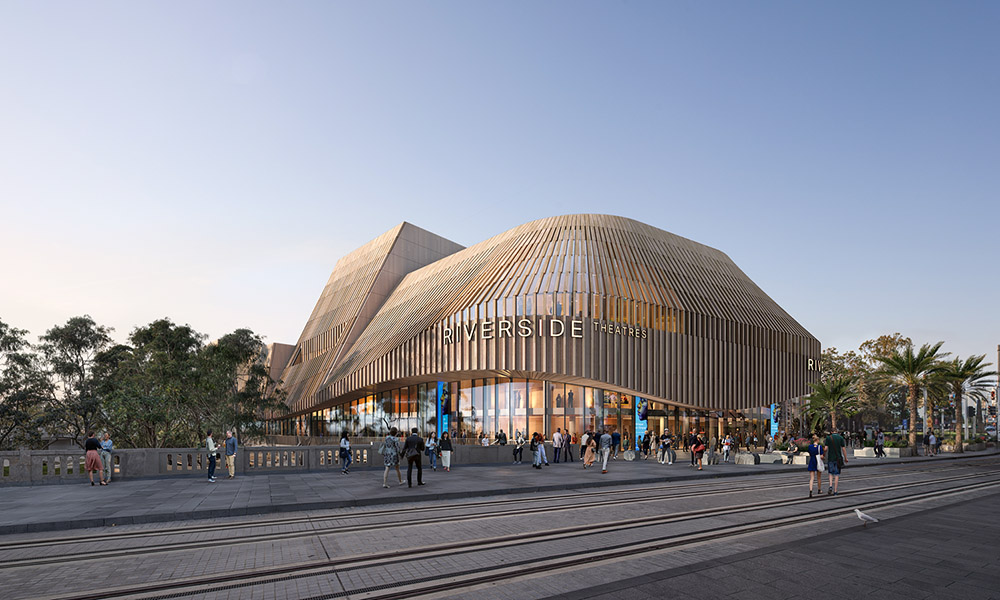
Scaled Back, Still Ambitious: Inside the Turbulent Rebirth of Sydney’s Riverside Theatres
For nearly four decades, Riverside Theatres has stood as a cultural anchor in Parramatta, nurturing the artistic life of western Sydney. When the City of Parramatta unveiled plans in 2024 to transform the ageing complex into a “world class performing arts centre,” the project was hailed as a defining moment for the rapidly growing region. A Broadway style lyric theatre, upgraded performance spaces and a cutting edge digital studio were set to elevate the precinct into a major arts destination rivalling those in central Sydney.
Today, that vision remains intact in spirit, but not in scale.
A series of escalating cost blowouts has forced the ambitious redevelopment into a dramatic rethink, culminating in a late night council meeting this week that confirmed the project will be redesigned and scaled back. Tenders submitted to council far exceeded the approved $276.8 million budget, with some proposals returning at an eye watering $355 million, nearly double the original estimate unveiled just 18 months ago.
Faced with material budget variances, unresolved construction risks and a growing financial gap, councillors agreed to halt the process and move the project into an early contractor involvement phase. This approach, increasingly common on high value public builds, will allow experts to redesign and value engineer the precinct to ensure it can still be delivered without breaching the existing budget ceiling.
The decision brings relief to those concerned about spiralling costs, but it also confirms what insiders had already anticipated: the final redevelopment will be a scaled back version of the once sweeping proposal.
From world class promise to procurement pressure
The original redevelopment plan promised a major lift to Parramatta’s arts infrastructure. It included a 1500 seat lyric theatre designed to attract major commercial musicals, a refurbished 700 seat playhouse, a new 325 seat black box space, and a 110 seat digital studio and cinema. At launch, the price tag of $188 million seemed plausible, even optimistic.
By mid 2025, however, the figure had jumped to $276 million, leaving council scrambling to fill a $93 million funding gap through philanthropic efforts and capital reserves. Internal warnings escalated. Confidential advice from the state’s audit office flagged an “extreme risk” that the project lacked sufficient capital to achieve the full design. Those warnings were validated when tenders returned far above expectations.
Compounding the challenges, Parramatta’s bid for $50 million from the federal Urban Precincts and Partnerships program was unsuccessful, eliminating a key potential funding source at a crucial moment.
A delay, not a derailment
The budget clash has pushed the construction timeline back by at least a year. The theatre was scheduled to close at the end of 2025, but it will now remain open until October 2026, with works beginning “later in 2026.” Opening night for the redeveloped venue, originally targeted for 2028, is now likely to slip further depending on the outcome of the redesign.
Despite the setbacks, Parramatta Lord Mayor Martin Zaiter maintains that the project is far from compromised. He emphasises that the redesign will allow the city to optimise the build, protect taxpayers and maintain the core promise of a premium performing arts centre in the heart of the CBD. Officials argue that the early contractor involvement stage reflects best practice for complex capital works and will ultimately yield a stronger, more sustainable project.
A pattern of infrastructure pressure
The Riverside redevelopment is not the only Parramatta initiative facing financial headwinds. Plans to upgrade the Epping Aquatic Centre were abandoned earlier this year when its $26 million budget ballooned to nearly double. Instead, the facility will undergo minimum renewal works before reopening in 2027.
Together, the projects paint a picture of a city grappling with infrastructure ambitions that outpace rapidly shifting construction costs.
What comes next?
For artists, audiences and industry stakeholders, the redesign represents both a setback and a second chance. While some features may be trimmed, the fundamental goal remains unchanged: to deliver a modern, versatile theatre precinct capable of serving a fast growing population and attracting major productions to western Sydney.
The coming months will determine what the new Riverside will look like, how much of its original vision survives and how Parramatta balances aspiration with financial reality.
One thing is clear: even scaled back, the redevelopment of Riverside Theatres will be one of the most closely watched arts infrastructure projects in the country, carrying the weight of community expectations and the promise of a cultural future still within reach.