Rewriting the National Score: Vidya Makan and Sonya Suares on THE LUCKY COUNTRY
What does it mean to belong in a country still reckoning with its past?
In The Lucky Country, a bold new Australian musical co-created by Vidya Makan and Sonya Suares, the myths of national identity are pulled apart and reimagined through song, satire, and searing honesty.
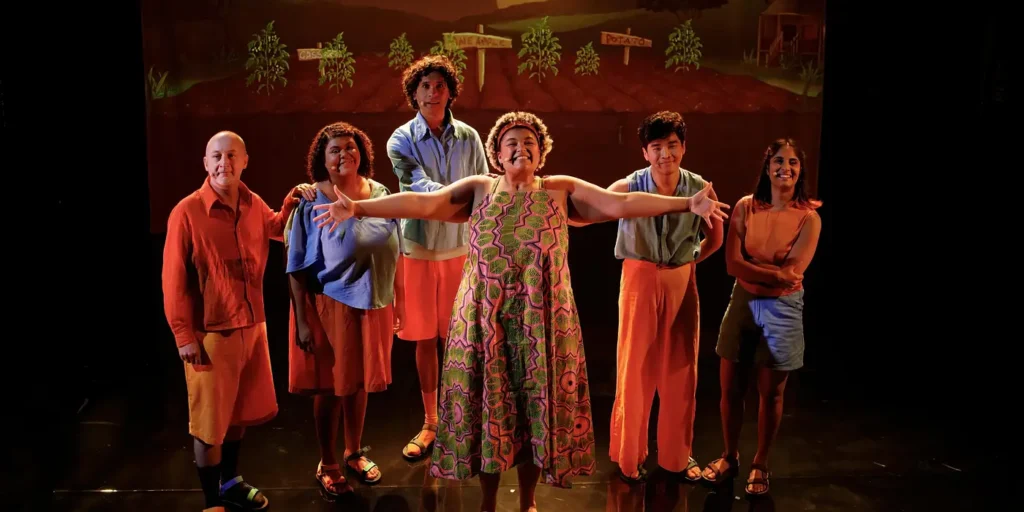
At the heart of the story is Boy, a 13-year-old Thiitharr Warra kid whose youthful optimism is fractured when his teacher’s version of “our shared history” clashes with his lived experience. His journey of self-actualisation leads him back to Country and into a reckoning with truth, memory, and identity. But Boy is not alone. As he navigates the fault lines of Australia’s national narrative, we meet a chorus of quintessentially Aussie characters: grey nomads who fall in love on a Contiki tour, a Chinese Australian restaurateur with dreams of Byron Bay nudism, a young refugee finding community in Mingoola, a disillusioned WW2 veteran, a wannabe starlet, and even a fake Russian choir.
Through sharp humour, aching tenderness and a kaleidoscope of original music, The Lucky Country interrogates who gets to call this place home — and at what cost.
Vidya Makan is a multi-talented performer, writer, and composer best known for her work on stage in productions such as SIX the Musical and Hamilton. A passionate storyteller and fierce advocate for representation, she brings powerful vocal artistry and political insight to her work. The Lucky Country marks her debut as a composer-lyricist of a full-length original musical.
Sonya Suares is a Melbourne-based actor, director, and producer with a formidable presence in the Australian independent theatre scene. As the founder of Watch This, Australia’s first and only company dedicated to the works of Stephen Sondheim, Suares has championed intelligent, inclusive, and artistically rigorous theatre. With The Lucky Country, she brings her sharp directorial voice and political conviction to a landmark new Australian work.
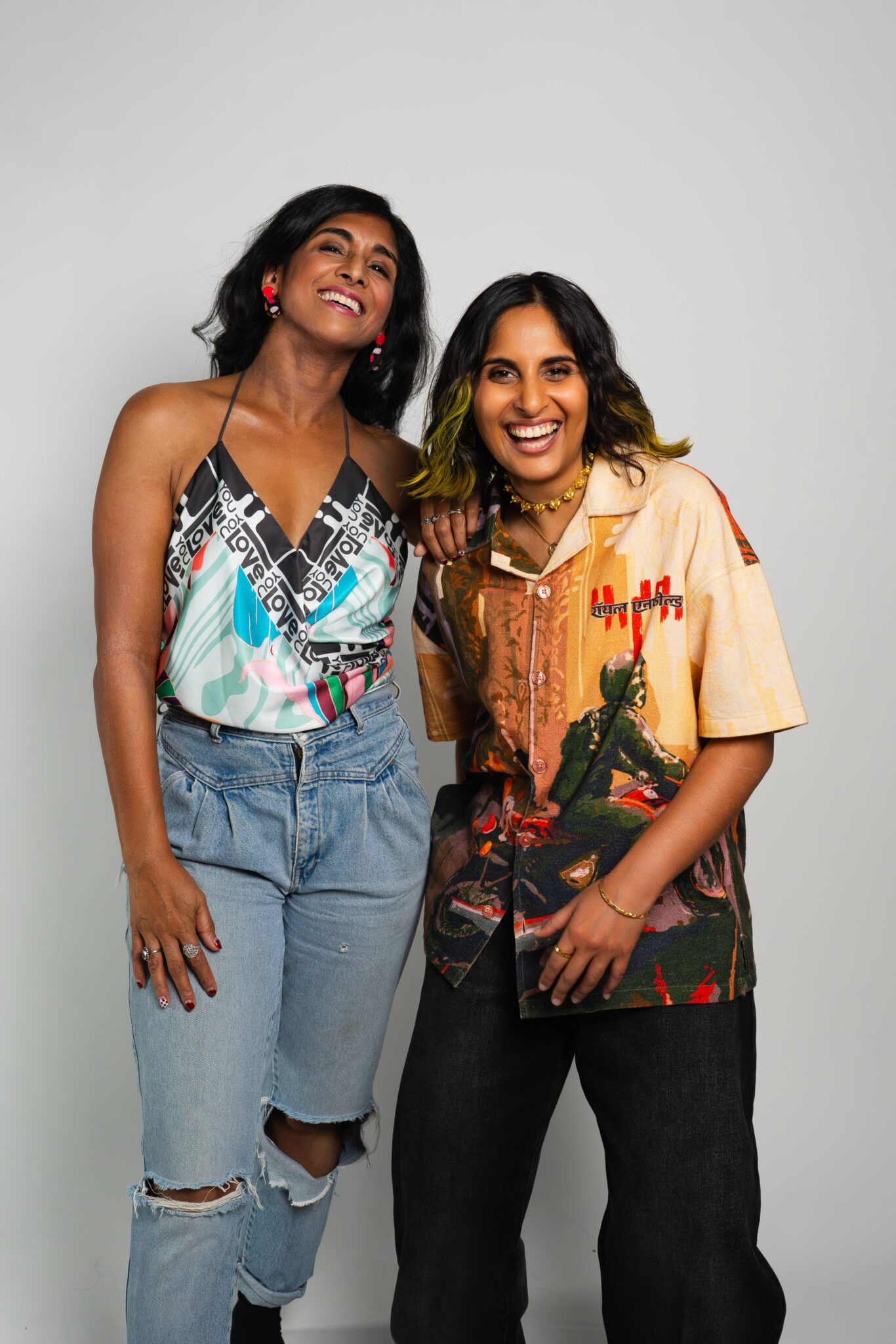
As the show prepares to open in Melbourne before heading to Brisbane, we chat with Vidya and Sonya to talk about the creative fire that fuels the production, the stories left out of our history books, and why this work feels more urgent than ever.
What was the starting point of The Lucky Country? Did it begin with a musical idea, a story, or a feeling?
Vidya: My honest answer to this is that I started writing the show in 2018 in a moment of frustration, grief and anger in the ways I was seeing minority voices represented in Australian musical theatre. I wanted to take up space in a way that was authentic, nuanced and to not have to be the butt of the joke. I wanted to be part of the joke! I wanted to write myself into the narrative. This is what drove me to write the first draft of the musical. A year later, Sonya came on board and made me realise that what I was trying to do was much bigger than I initially thought. It wasn’t just about writing myself into the narrative, but about actually examining the complexities in what makes up our national identity. There probably couldn’t be a more epic pitch for a musical! This then continued to expand as we continued to collaborate and consult with our brilliant First Nations artists, particularly my dear friend Chenoa Deemal. The show is still deeply personal, but has now expanded into something epic and beautiful. It is a meeting place.
The score for The Lucky Country pays homage to a huge range of Australian musical icons- How did you go about distilling such a diverse sonic history into a cohesive musical language?
Vidya: Truthfully, finding a cohesive language between all the songs was one of the trickiest parts of writing the show. In a way, the fact that they aren’t explicitly cohesive is the point. On the surface, they don’t sound like they have anything to do with each other and they shouldn’t appear in the same show! But they do. I think in many ways, that’s what Australia is. We are “one but many”. All these different genres and tunes… some sit next to each other neatly, others clash, but they still exist together. There is a way for them to co-exist. In our show world, that cohesion has a lot to do with Heidi Maguire’s brilliant orchestrations. She took our twelve songs, each with their own style and genre, and found a way to orchestrate them to sound magnificent in their own right, but to live beautifully together within the context or our show.
The show deals with identity and belonging through a very contemporary lens. How did these themes influence your songwriting and lyric choices?
Vidya: I basically wrote most of the songs in lockdown back in 2020. Sonya and I would meet 1.5 m apart on her nature strip, and talk through what characters and stories we wanted to tell. I would then go away and spend weeks researching this one theme/character/aspect of Australian culture, along with listening to music that might reflect that. For one of the songs, this was a week of listening solely to Aussie rock ballads; another week was solely listening to Kylie Minogue; another The Seekers (and so on). I wanted to get the feeling of these artists and stories under my skin, so when I eventually went to the piano and the laptop, our original songs sort of wrote themselves! Lyrics were a process of making choices and refining iteratively with Sonya – lots of conversations about character and clarity.
What’s something about The Lucky Country that you think might surprise people?
Sonya: That it is fucking funny! You might expect a show traversing this territory to be super earnest or worthy but this one is very often a total party vibe.
Vidya: It is the kind of theatre that takes audiences where they don’t expect to go. We don’t want to say too much; but from experience, audiences will be crying with laughter for a good 40 minutes, and then leave the theatre having also experienced something deeply profound.
Vidya, you’ve had a rich career as a performer in major musicals. How has your time on stage shaped the way you approach writing for theatre?
Vidya: I was in between seasons of SIX when majority of this show was written. Getting to meet Lucy Moss (Tony award winning lyricist and director of SIX) was a real life changing moment for me. She’s roughly my age, and wrote songs true to her. Doing the first season of SIX gave me license to write the kind of music that was true to me. It also gave me license to have a bit more fun with my writing. Why not include a Kylie Minogue inspired fever dream about all the things in Australia that can kill you!
Sonya, you’ve worked on major classics like Into the Woods and Sunday in the Park with George. What has it been like shifting from those iconic texts to something brand-new and homegrown?
Sonya: Oh gosh, I’ve spent stacks of my life in rooms making new Australian theatre, both as a freelancer and within orgs like Melbourne Theatre Company, Queensland Theatre, Griffin Theatre Company, Playwriting Australia, Polyglot Theatre, Arena Theatre, Antipodes Theatre, Darebin Speakeasy and Hayes Theatre Co. Even Watch This, the Sondheim repertory company I led for nearly a decade, has a branch dedicated to developing new work. So I felt right at home. In fact, there’s a link between classics like Woods, Sunday, Sweeney and The Lucky Country – they’re all bold and fiercely ambitious works that have something to say.
The show explicitly claims space for overlooked voices. How have you ensured that this intent is reflected in both casting and storytelling?
Sonya: Being curious about voices/ bodies/ lived experiences that have traditionally been minoritised is a recurring theme in my practice – and life! So for me, this process started when Vidya and I first started shaping the work in 2020. I was able to reflect back to her its scale: that at its core, this show wants to take on the grand narratives of Australian storytelling. My take was that while a literal representation of every Aussie is a blatantly impossible task, there is a way to ensure the storytelling is representative in its key beats, so that certain moments resonate out to multiple groups: e.g. “this is to Chinese Australians or the South Asian diaspora as this is to me”. Structurally, the arc of the show gifts us our scope, leading us to the fracture-lines at the heart of our nation. And form-wise it’s a concept musical that operates via layers rather than via a linear plot. So it’s not just the beats themselves but how they fold on top of each other moment by moment within the overall arc that ensures we’re meeting our dramatic intent. Casting flowed on from our story beats. We needed six kick-arse actor-singers who could play their own (or adjacent) lived experiences authentically, then next minute transform into a boat or film crew or a Miss Universe pageant or a bunch of faux-Russian clowns. It was a process, but I reckon we nailed it!
How did your collaborative dynamic shape the final work?
Vidya: Writing this work has been incredibly challenging at times. But Sonya and I thrive off a robust, rigorous and honest dynamic. We needed that in order to make a work this ambitious! We needed to be straight up with each other. A lot of the process was us laughing at our own jokes, but there were also many times where we had to have those difficult conversations. But that in itself is a form of love.
Sonya: And really, this dynamic mirrors the overarching thesis of our show. When you care about something – a relationship, a show, a country – if there’s love and you’re invested, then you want it to be all that it can be. Which means you have to have the courage of your convictions, even when it’s difficult. “Love it or leave” is one of the more stupid slogans I’ve come across in my lifetime. Holding ourselves to our values is an act of citizenship, an act of love.
Vidya: We both want the best for this country, and we want the best for our show. This has meant we have both had to be really humble at times. We have had to really learn how to listen.
Why do you think now is the right time to tell this story?
Sonya: It is always the right time to tell this story. As people, we are never done thinking about ways that we can grow/ how we can be better – whether we choose to or whether life forces us to. Likewise, that’s the constant, collective journey for us as a nation. The alternative is stagnation … or regression. I think we can see clear examples that the alternative isn’t pretty.
Vidya: The last few years in particular, there has been a real microscope on these kind of conversations and whether we need them or not. Something I think we can all agree on is that we absolutely do. We should never be done talking or thinking about how and who we can be.
What do you hope audiences leave questioning or feeling after seeing The Lucky Country?
Sonya: I hope they leave feeling seen. Moved. Optimistic that we can shape our own future – that collectively, we have that power. And that “the act of defiance can be joyful and unifying”. That’s a direct quote from a review of our Sydney season. I have to admit I teared up when I read it – it’s exactly what I’d want audiences to walk away feeling.
The Lucky Country will tour to Melbourne and Brisbane this October.
For tickets and more information, visit www.luckycountrymusical.com
Header photo from the 2023 Hayes Theatre season.