Into the Paddock: Carly Sheppard and Alisdair Macindoe on THE SHEPHERDS
In The Shepherds, two sheep wander through a slaughter paddock searching for the figure who determined their fate. What unfolds is not simply a dance work, but a darkly comic and deeply symbolic meditation on Australian mythmaking, inheritance and the uneasy relationship between care and violence. Blending choreography, theatre, ritual and surreal pastoral imagery, the work transforms familiar symbols of rural Australia into something unstable and haunting — a theatrical landscape where bodies carry the aftershocks of colonial invasion, ecological destruction and fractured ancestry. Moving between absurd humour and quiet devastation, The Shepherds asks how stories are inherited, who gets to shape them, and whether new futures can emerge from the ruins of old myths.
Presented as part of the inaugural Australian Dance Biennale, curated and hosted by RISING, the production marks a major collaboration between acclaimed contemporary artists Carly Sheppard and Alisdair Macindoe. Together, the pair construct a world that feels at once ancient and futuristic, ceremonial and chaotic — using abstraction, movement and iconography to confront the lingering realities of life on stolen land without ever settling into direct retelling. Instead, The Shepherds creates a symbolic ecosystem where tenderness, brutality, humour and grief are constantly colliding.
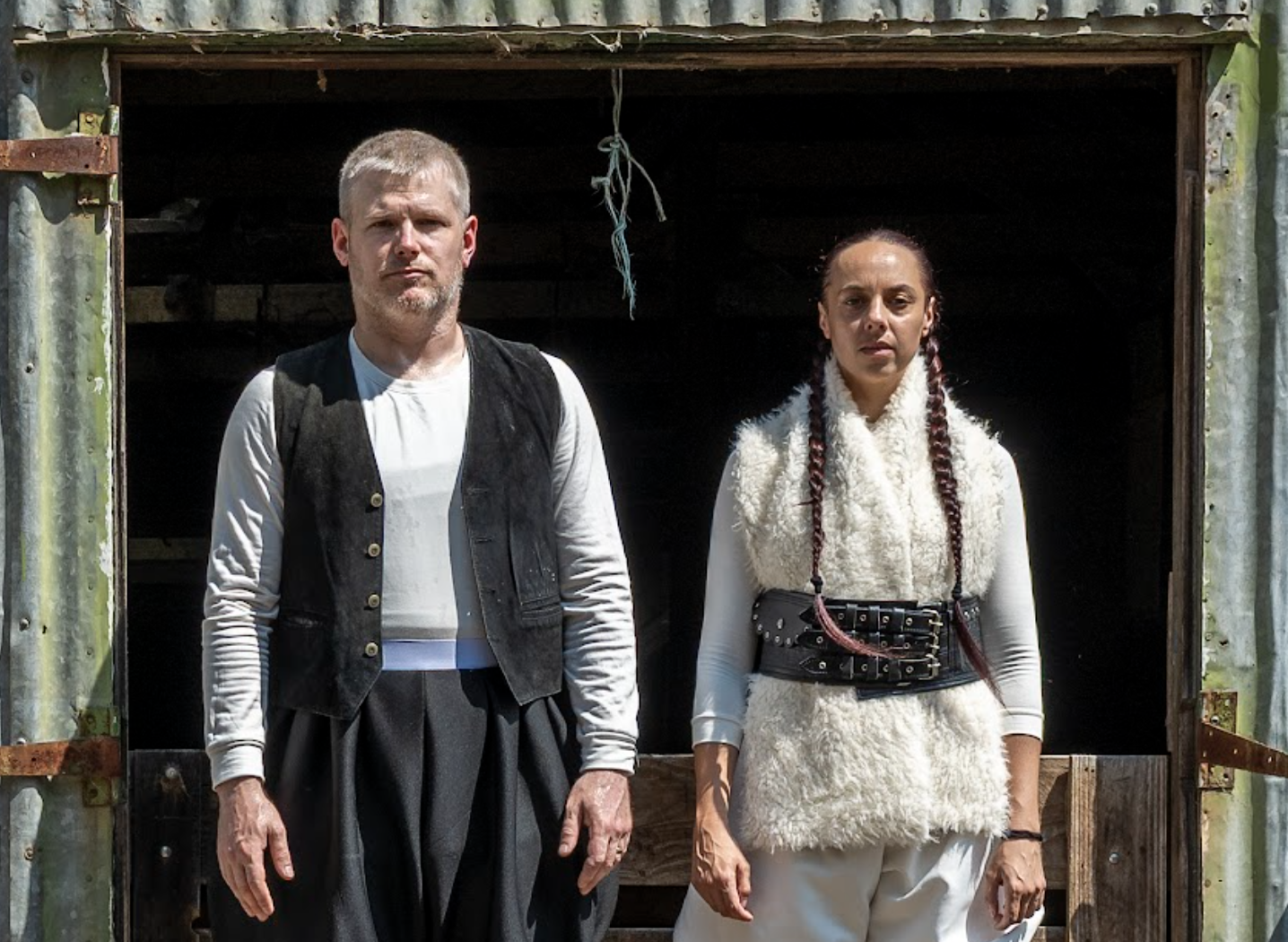
A Wallangamma and Takalaka artist, Carly Sheppard is a celebrated cross-disciplinary performance maker whose practice spans dance, theatre, sculpture, drawing, voice and installation. Her work frequently explores class, Indigenous diaspora, intersecting identities and the navigation of personal and collective trans-generational inheritances. She has previously collaborated with organisations including Malthouse Theatre, Joel Bray Dance and Performing Lines, with acclaimed works including Crackers N Dip With Chase N Toey, Love and Anthem earning multiple Green Room Awards and nominations. A graduate of the Victorian College of the Arts, NAISDA and the University of Melbourne, Sheppard’s work is recognised for its striking emotional honesty and fearless interdisciplinary experimentation.
Alisdair Macindoe is an award-winning independent choreographer and multidisciplinary artist whose concept-driven works span dance, sound, electronics, coding and text. Based on Wurundjeri Woi-wurrung Country in Naarm/Melbourne, his practice pushes the boundaries of choreography through explorations of artificial intelligence, automation, transhumanism, climate change and identity in the digital age. His work has been commissioned and presented nationally and internationally through organisations including Sydney Opera House, Arts Centre Melbourne, Australasian Dance Collective and Lucy Guerin Inc. Across a career spanning more than twenty years, Macindoe has received six Green Room Awards, a Helpmann Award and a New York Performing Arts “Bessie” Award, establishing himself as one of Australia’s most inventive contemporary dance-makers.
Together, Sheppard and Macindoe bring those distinct artistic lineages into conversation in The Shepherds — a work that resists easy interpretation while confronting some of the deepest fault lines within Australian identity, memory and storytelling.
What are the Shepherds in this work, and what are they tending?
Carly and Alisdair: For us the “shepherd” is iconography first a familiar pastoral figure that reads as care, guidance, management, ownership. We lean into that recognisability because it lets us build a fantasy world the audience can enter quickly, and then gradually realise the ground underneath it is unstable. What they’re tending is deliberately ambiguous: a flock, a story, a set of inherited roles. And because this is stolen land, the pastoral image is never innocent. The shepherd becomes a theatrical device to hold that contradiction soft imagery carrying hard truth. We’re not retelling history directly; we’re building a symbolic ecosystem where the violence that founded the nation keeps surfacing through bodies, objects, and atmosphere.
How did the two of you come to collaborate on The Shepherds? What does each of you bring to the partnership?
Carly and Alisdair: The Shepherds was commissioned through the Sydney Myer Foundation, via a commissioning program designed to bring Myer Fellows together and generate new work. That framework didn’t just pair the two of us it also helped convene many of the major collaborators around the project, and set the work up from the beginning as something collectively built. Artistically, the partnership works because we’re both drawn to making performance worlds places with their own rules, visual logic, and internal mythology. We like working in a way that’s part conversation, part misadventure: you follow images, jokes, unease, and sudden moments of clarity, rather than a tidy thesis. Each of us brings different lineages, different sensitivities, and different instincts about where meaning lives whether in a gesture, a prop, a tonal shift, a rupture in rhythm. That difference is generative: it keeps the work from settling into one perspective, and lets humour and grief, tenderness and brutality, symbolism and plain human presence all coexist.
Can you talk about the movement language you’ve developed for this piece – what does it look like, feel like?
Carly and Alisdair: The movement language sits between creature and ritual. There are echoes of flocking, circling, drifting, being pulled by an invisible force herd logic but it’s not naturalism. It’s choreography built from pressure: containment, compliance, collapse, stubbornness, play. We’re interested in how a body can carry story without illustrating it. The dance can feel ceremonial, then absurd, then suddenly intimate. And because we’re working with fantasy, the movement is allowed to mutate animal, human, omen, labour like the body is trying on roles it didn’t choose, on a continent where those roles were assigned through invasion.
How does the work engage with the idea of care, or caregiving, if it does at all?
Carly and Alisdair: Care is one of the emotional engines of the piece, but we treat it as a complicated material. Shepherding is care that can slide into control; protection that can become possession. We explore that artistically through proximity, touch, withholding, support, repetition, and the aesthetics of “management.” Rather than stating an argument, we stage conditions: who gets held, who gets handled, who gets left behind, what tenderness looks like when it’s strained. The fantasy frame lets us look at those dynamics sideways so the audience feels the contradiction before they name it. And in a country still bleeding from genocide, “care” is never just a gentle word it’s a contested act with consequences.
What role does the audience play in this work – are they the flock, the witnesses, or something else?
Carly and Alisdair: We think of the audience as entering a constructed world and becoming part of its meaning-making. They might feel like witnesses to a strange ceremony, or like the flock being addressed, or like an implied authority the performers are reacting to. We like that instability it keeps the audience’s position moving. Because the work is built from abstraction and iconography, the audience is invited to do a kind of reading: to connect images, to fill in gaps, to decide what feels familiar, what feels wrong, what feels too close to real life. The “story” is partly what they assemble.
What do you hope lingers with audiences after they’ve seen The Shepherds?
Carly and Alisdair: We hope what lingers is the world of the work the texture of it: a few potent images, a tone, a bodily memory, a strange tenderness, a laugh that has something sharp inside it. And underneath that, we hope people carry the sense that these symbols aren’t neutral here. Pastoral beauty in Australia sits on top of a brutal foundation stolen land, unended frontier war, and the ongoing afterlife of that violence. We want audiences to leave not with a lesson, but with an echo: a feeling that fantasy can be a truthful container, and that abstraction can sometimes let you hold what direct language can’t.
The Shepherds plays at Arts House, Melbourne as part of RISING festival.
For tickets and more information, visit the RISING website.
Header photo by Tiffany Garvie