
Inside Simon Hewett’s QYO Revolution
As Artistic Director of Queensland Youth Orchestras (QYO), Simon Hewett brings a wealth of international experience to the podium — but his passion is firmly rooted in Queensland. Having conducted renowned ensembles across Europe, including the Stuttgarter Philharmoniker, Hewett now channels that global insight into nurturing the next generation of orchestral talent right here at home. He sees QYO not just as a training ground, but as the musical equivalent of the Queensland Institute of Sport: a place where dedication meets inspiration, and young musicians push themselves to reach the extraordinary.
In this wide-ranging interview, Hewett shares how he balances discipline and joy in the rehearsal room, the powerful emotional resonance of works like Star Wars and Walton’s Symphony No. 2, and the immense value of internal motivation in a young musician’s journey. He reflects on his own path to conducting, shaped by both awe and anxiety, and reveals the transformative potential of orchestral music — not only for audiences, but for the performers themselves. As QYO prepares for a dynamic season ahead, including plans to commission Queensland composers for the 2032 Olympics, Hewett’s vision is clear: music, when pursued with purpose and passion, can unlock a lifetime of confidence, connection, and creativity.
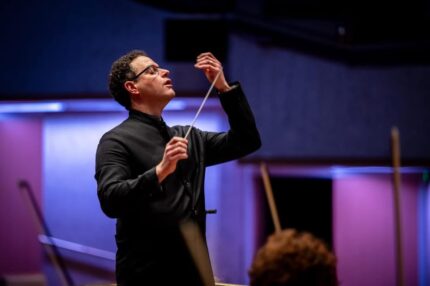
Photo by Christopher Pitstock
1. You’ve conducted orchestras around the world, including the Stuttgarter Philharmoniker, what have you learned from working with international ensembles that you now bring to QYO?
Queensland is one of the only places in the world which has a Government-funded instrumental music program in our primary and secondary schools. Per capita, a greater number of kids in Queensland learn orchestral instruments than almost anywhere else in the world! QYO benefits from this program as the kids who audition for QYO are the ones who want a bigger challenge. QYO is like the Queensland Institute of Sport, but for music. At QYO our young musicians get to know other young people just as passionate about music as they are. But young Queensland musicians are not always aware how good they are. I want our young musicians to have the confidence to dream big and know they can go out into the world and match it with anyone, anywhere!
2. As a conductor, how do you balance discipline and creativity, especially when working with such passionate and developing young musicians?
‘Play’ is such an important word. A musician ‘plays’ a musical instrument. Even though all musical instruments are actually pieces of machinery (some simple, some complex), we don’t ‘type’ at a piano, ‘work’ a tuba or ‘operate’ a violin. Playing music should never feel like a chore. If it is not fun, you are doing something wrong. The same is true for me as a conductor.
If the musicians are having fun, and know what we want to achieve, then repeating a passage 17 times is not a challenge or boring. Once young musicians hear what beautifully crafted orchestral music sounds like (and how it feels) they want to achieve that every time. If I am really clear about what QYO stands for — and what our expectations are — when they sign up, everybody in the group knows what they are getting into. If everyone has the same shared goals and aspirations, then discipline doesn’t really come into it. We all want the same thing.
3. What drew you to music as a lifelong career, and was there a particular moment or piece that solidified your path as a conductor?
I have known I wanted to be a musician since I was 12, when through the clarinet I first discovered Mozart, Brahms, Mahler, Strauss and Mahler (… and the list goes on). It is the only thing I ever wanted to do. It was not a choice. Daily, I wanted to spend hours and hours playing music, listening to music, thinking about music, and reading about music.
For me, conducting happened fairly organically. At the age of 14, I realised as a conductor I would have a vast amount of repertoire to explore — more than one person can really get across in a single lifetime! Some personal factors came into it as well – as a teenager I was very shy, and even insecure about the judgement of my peers. The challenge of learning how to guide and lead a large orchestra of 80 to100 musicians — with all its musical and human complexity — just seemed like the ultimate way of facing down that fear. I hated that feeling of anxiety and I hoped learning to conduct would help me conquer it. Thirty years on, it is still a work in progress, but the anxiety has turned into more of a healthy respect for the orchestral musicians I work with.
4. The Star Wars Suite is both technically challenging and universally loved, how do you approach making it both musically rigorous and emotionally resonant for the performers and the audience?
We have all heard many of these famous themes countless times before, but we don’t just play them how we think the music goes. Instead, we actually look at the rhythms on the page and play them. That is something I emphasise throughout the rehearsal period.
5. You’ve said this is ideal ‘gateway music’ for new audiences. In your experience, what kind of impact can a concert like Empire of Sound have on someone experiencing orchestral music for the first time?
Everybody loves orchestral music. I have yet to meet a person who doesn’t feel excited or moved when listening to John Williams’ scores. I hope by putting the orchestra front and centre people will realise their emotional response to films like Star Wars is as much a response to the music as it is to the story and to the visual aspects of the films. I want our audience to realise they already have a strong emotional connection to orchestral music — and I hope this will inspire them to discover more orchestral works and come to more orchestral concerts.
6. William Walton’s Symphony No. 2 is a more complex and less familiar choice. What do you hope audiences will take away from hearing this work alongside John Williams’ score?
No artist creates in a vacuum and John Williams’ incredible craft and creativity, composing for orchestra, uses many techniques that were invented by earlier composers. While it has not (yet) attracted a wide audience, Walton’s Symphony No. 2 has a small but devoted circle of admirers. Film composers have used it for decades as a reference tool — borrowing its many innovative orchestral techniques for myriad purposes in numerous films. After listening to both Walton’s 2nd Symphony and the selections from Star Wars, I hope that our audience realises there is SO MUCH fabulous orchestral music to explore that sounds similar to the movie music they know and love.
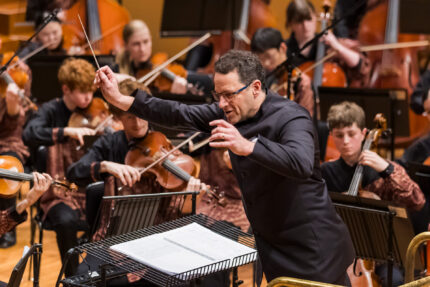
Photo by Alex Jamieson
7. QYO musicians are tackling some of the most challenging works in the symphonic repertoire. How do you support them to meet these high standards while still nurturing their love for music?
That takes care of itself. Talented and motivated young climbers, when they are ready to tackle a big and challenging mountain, are self-motivated. No one is forcing them to be there. The same is true with QYO musicians. They are there because they love orchestral music and want to tackle the biggest, most challenging works of the orchestral repertoire. Each year when I ask for suggestions for next year’s repertoire, the players bombard me with ambitious suggestions. If I were to program less-challenging works, the top players wouldn’t re-audition and I wouldn’t have an orchestra.
8. With so many competing interests for young people today, how do you keep classical music, and orchestral playing in particular, relevant and exciting for them?
The young musicians I interact with in QYS (QYO’s top orchestra) are already very excited by classical music and orchestral repertoire. Most of them have spent several years progressing through our less-advanced ensembles and orchestras, and before they came to QYO most had been playing their instruments for four to five years.
I believe doing things that require skill and application are inherently pleasurable … once you get beyond the ‘beginner’ level. Think about the process of learning to ride a bike or surf or draw or juggle! I could go on and on. My point is this: We need to support young people through that critical early stage of learning a musical instrument.
When you get to the stage when the child thinks to themselves ‘this is fun’, you need to get out of the way and let them have ownership of their own journey of discovery (while still helping them avoid developing a poor technique or bad practise habits). Internal motivation is the only kind of motivation I am interested in. Why? Because it will nourish and sustain a child for their whole life. External motivation doesn’t last.
9. Are there any future projects or pieces you’re especially eager to introduce to the QYO, either for their musical ambition or emotional power?
Mahler’s 7th or 8th Symphonies, Schoeberg’s Gurrelieder and Janacek’s Sinfonietta.
I am dedicated to nurturing and developing young talented composers, from all over Queensland, to write works for all QYO groups to perform in an Olympics Youth Music Festival in 2032.
10. If you could tell every young person in Australia one thing about the power of orchestral music, what would it be?
Imagine the adrenalin rush, and dopamine hit, of nailing the highest level of your favourite computer game — played in real time, with your best friends alongside you. That is what playing in an orchestra feels like!