Inside La Boite’s MACBETH: A Feminist, Eco-Conscious Reimagining
In this bold new production of MACBETH, the Witches transcend the usual role of shadowy instigators, instead acting as narrators who critique humanity’s relentless ambition. Opening on International Women’s Day, this reimagining fuses dance, movement, text, and sound to create a vibrant hybrid performance. Yet there’s much more than choreographic spectacle at play: woven into every scene is a poignant plea for ecological balance and a searing feminist perspective—one that resonates urgently in our world of climate crises and ongoing battles for women’s rights.
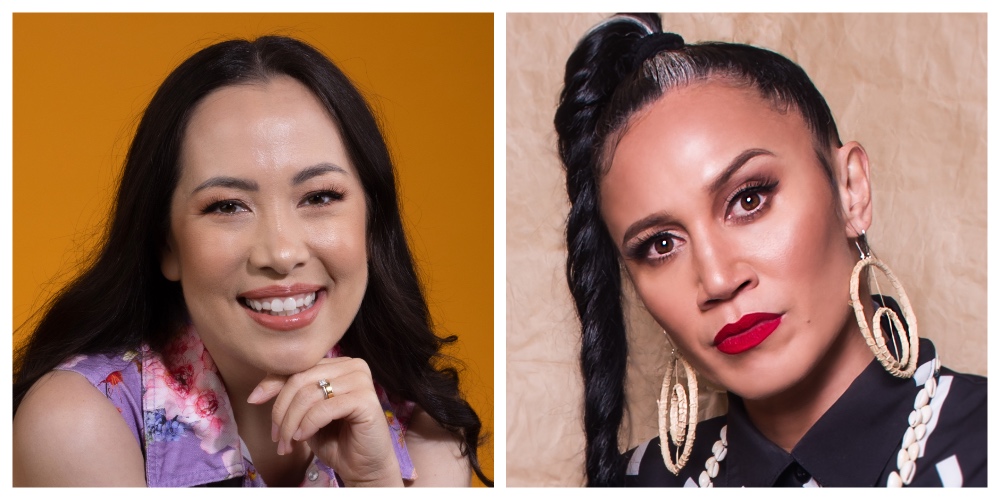
The production’s co-directors share their insights on granting the Witches such visceral prominence, unveiling how these often-marginalised characters can shed new light on Shakespeare’s tragic hero. From ecological commentary to the power of local voices, this conversation examines how centuries-old words can galvanise us anew—challenging our complacency and igniting a collective call for change.
The Witches are often seen as secondary catalysts in MACBETH, but here they take centre stage. What inspired you both to elevate their voices, and how does this choice alter the core meaning of Shakespeare’s original tragedy?
Shakespeare’s original tragedy could not happen if it weren’t for the witches. One gets the impression when reading the play that the witches are present even if they are not onstage. Both Macbeth and Lady Macbeth have scenes where the witches are not present where they call on the spirits and Hecate to assist them in their plans, and if Macbeth did not meet the witches early in the play, he would not receive the prophecies that drive him to become king. The witches are characters that are equally as important as Macbeth and Lady Macbeth, and this production highlights and elevates this idea. By deploying the Witches as narrators, as conduits to the audience, it allows us to look particularly at the character of Macbeth with a fresh lens – it allows us to drill right down to the core question “how far are you prepared to go to get what you want”.
Your production seems to present the Witches as a manifestation of the Earth’s voice, critiquing human ambition and ecological harm. Can you talk about the creative process that led you to emphasise this environmental dimension?
Again, in the original version of Shakespeare’s tragedy Macbeth, he references the environment all of the time. When things are going badly (which is for most of the play), the weather and environmental elements get progressively worse. Many of the scenes that Shakespeare wrote are set at night, or very early in the morning, and for a man who wrote using very few stage directions, in this play he calls for thunder quite a lot. Theatrically also, when you have magic, bubbling cauldrons and futuristic prophecies, using the environment to punctuate the drama is a great device. Witches are innately connected to the world around them, they represent the interconnectedness of all things. Our Witches are healers – their job is to maintain the natural balance of the world.
Opening on International Women’s Day is a powerful statement. What does it mean to reimagine Shakespeare through a feminist lens, and how do you hope this timing will shape the way audiences engage with your show?
Opening on International Women’s Day is a powerful statement, especially considering the current global climate. In Australia, we’re seeing devastating headlines like “One woman dies a week due to domestic and family violence.” Meanwhile, women’s rights are being rolled back in America, with Queensland following suit and enacting laws that harm the trans community. In this context, reimagining Shakespeare through a feminist lens becomes not just relevant, but urgent. By bringing Macbeth—a story of power and ambition—to the stage through the eyes of women, we aim to challenge the status quo and reflect the struggles we face today.
This timing gives us the opportunity to pause, step away from the noise of our screens, and really consider the cycles of power and violence that continue to shape our world. Do we accept this as our reality, letting history repeat itself and for this 400-year-old story still ring true? Or do we use this moment to question the narratives we’ve inherited and choose a different future?
This reimagining blends dance, movement, text, and sound in a hybrid performance. How do you negotiate the balance between choreography and Shakespeare’s iconic language, ensuring neither overshadows the other?
I believe that when working from a multidisciplinary approach, each form—whether it’s dance, movement, text, or sound—can and should coexist equally, with none overshadowing the other. It’s true that balancing this with Shakespeare’s language can be challenging, especially given its antiquity, but as BIPOC creatives and performers, we’re returning to a natural, ancestral way of storytelling. For us, it’s instinctive to dance, to sing, to move, and to fully inhabit the present moment. We’re energy manipulators in that space, weaving the story together through both physical expression and iconic language, creating a seamless dialogue between them.
The central themes of power and ambition resonate strongly in our modern world. How do you believe this production’s focus on the Witches invites audiences to reflect on the consequences of our own collective ‘ambitions’ today?
In a world where the darkest sides of humanity are constantly streaming before us, our collective conscience is questioning what true liberation might look like. The Witches in this production symbolise the female global majority, a group disproportionately impacted by the power struggles and ambitions that shape our world. As our witches—who are also healers and knowledge keepers—take center stage as the storytellers, we hope their perspective will guide audiences toward greater understanding, empathy, and ultimately, a call to action. Through their lens, we invite viewers to reflect on the consequences of unchecked ambition and to consider how we might create a more just and liberated world for all.
 You’re both co-directing, and you also have Sue Rider returning as dramaturg. How do you collaborate to unify your different directorial perspectives and styles, especially with such an experimental take on a classic text?
Our collaboration is rooted in deep, ongoing conversations and a genuine joy in working together. We all have immense respect for each other’s craft, and as women, we’re accustomed to navigating spaces with empathy and openness, which allows us to set egos aside and truly see things from one another’s perspectives. We make space for each other to be heard, valued, and supported, and we work to bring each other’s vision to life. This approach mirrors what we hope to achieve with the play—creating a platform where the Witches’ stories are truly heard. So, it’s no surprise that our collaboration has felt seamless and enriched with mutual support.
The Witches are often portrayed as ominous or malevolent, but your production gives them a deep spiritual and philosophical connection to nature. What challenges and opportunities did you encounter when humanising these often-mystified characters?
People like to think of witches as ugly old hags who are evil and malevolent, however they are not written to be malevolent in the play. The witches are quite neutral in Shakespeare’s original text. Whilst they often talk in riddles, they only speak the truth to Macbeth and Banquo, and do not manufacture situations to cause the downfall of any character, they observe and comment in an impartial way to the situations that the other characters in the play are creating. In this production, because we have combined quite a lot of the secondary characters and given their lines to the witches, these witches are less partial than the witches in Shakespeare’s original text, although you will get the distinct feeling that they are equally as horrified by the state of the world in turmoil and war as the honourable characters in the play. The incredible cast have brought this vision to life in a way we could only dream of.
Macbeth is a play dripping with blood, guilt, and horror. How did you approach the portrayal of violence and madness in a way that aligns with the production’s overarching ecological and feminist themes?
We have not shied away from the blood, violence and horror in the play, and like any good psychopath in a modern-day horror film, Macbeth is a villain that the audience loves to hate. He has some beautiful poetry in his lines, and is an intelligent and valorous warrior, at the start of the play who is much admired and rewarded by king and country. He just becomes overly ambitious and starts to remove everyone who stands in his way or suspects him. Whilst sometimes our horror is stylised or portrayed as a movement piece, it is very clear what we are trying to portray, and we hope that our audiences will find it scary and chilling.
This show incorporates local cast members and emphasises themes of interconnectedness. Could you share how specific cultural and community influences have shaped the performance’s design, movement, or overall aesthetic?
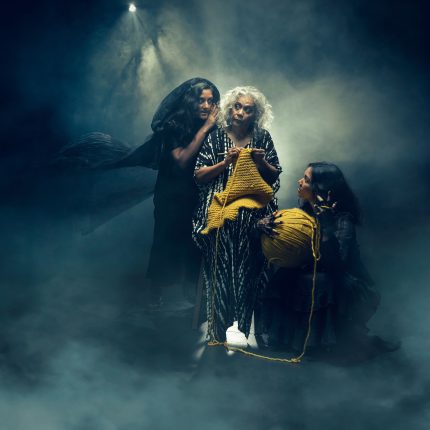
From the outset, we envisioned our Witches as everyday women—women whose DNA carries the same story that has echoed for millennia, whose bodies continue the essential work that has long been defined as “women’s work.” We wanted the space to reflect this enduring, intergenerational labor. I proposed a large, central weave piece that could transform the space, while also symbolizing the ongoing work these women carry forward. To bring this idea to life, I collaborated with master weavers Ranu James, Nata Richards and Maryann Talia Pau, to create a stunning piece inspired by the traditional Papua New Guinea Bilum weave. The Bilum, which means “womb” in Tok Pisin, originally served to carry babies and has now evolved into a versatile everyday bag, used to carry groceries, tools, and continue the work.
The connection is also deeply personal—cast member Mel Ree, who plays Macbeth, is from Papua New Guinea, so this cultural thread runs throughout the production. The practice of weaving across the Asia-Pacific remains a common thread, and it feels vital that this tradition is woven into our performance, both literally and metaphorically.
What do you hope the audience will carry with them once the lights go down—both in terms of Shakespeare’s centuries-old cautionary tale and this new angle that positions the Witches as agents of the Earth, crying out for balance and healing?
We had a discussion at the start of rehearsals as to why we wanted to tell this story in this way, and it is equally as relevant now as it was when Shakespeare wrote it centuries ago. Macbeth could be any number of dictators in any number of countries around the world today.Tonight, the witches are telling the story of Macbeth. Tomorrow they might tell the story of another modern dictator. This is a cautionary tale from the witches and the rest of the production team working on La Boite’s Macbeth, it’s a call to action – we need to stay connected to each other and continue to exercise our empathetic muscles. We want to push for a world where everyone, every community can thrive.