Do We Really Hear the People Sing? The Theatre Industry and the Politics of Performance
There is something faintly surreal about sitting in a theatre watching performers sing about resistance and moral reckoning, while outside the doors the world feels increasingly brittle.
Broadway and the West End are, on paper, in a politically engaged moment. The works dominating marquees and critical discourse are not escapist fare. They interrogate power, nationalism, class, race, identity, and the uneasy inheritance of history. Fascism, revolution, and the damage inflicted by institutions meant to protect are central to their concerns. These are not subtle texts. They announce their politics loudly and often proudly.
And yet there is a growing sense that something does not quite add up.
Theatre has always been politically vital: a space where difficult conversations happen in the dark, where audiences are stirred into empathy and perhaps even action. But the current climate makes that self-image harder to sustain. Outside theatre walls, political violence is no longer theoretical. Racism, antisemitism, Islamophobia, and xenophobia are not historical abstractions. Anti-immigrant sentiment has hardened into policy and popular rhetoric. Economic precarity is not a metaphor. These are lived realities, escalating in ways that feel increasingly incompatible with the comfort, insulation, and cost of the spaces in which these stories are now being told.
Cabaret has never felt more pointed. In its current revival, the musical leans harder into its warning: decadence is not neutral, silence is complicity, and authoritarianism rarely announces itself politely. The Kit Kat Club becomes a mirror held up to complacency, implicating audiences in the slow normalisation of cruelty and control. In a political moment marked by democratic erosion, emboldened extremism, and the weaponisation of culture wars, Cabaret reads less as historical allegory than as diagnosis. And yet its danger remains carefully framed, contained within the theatrical experience.
That tension sharpens when placed alongside Parade. Jason Robert Brown’s musical about the wrongful conviction and lynching of Leo Frank confronts antisemitism not as subtext but as explicit, sanctioned violence. Its recent Broadway revival and subsequent U.S. tour insist that antisemitism is not an aberration of history but one of its enduring engines. Parade refuses euphemism; it names bigotry and shows its consequences. Yet it also exposes the limits of theatrical reckoning. Audiences are asked to mourn a past injustice while antisemitic incidents, alongside broader attacks on minoritised communities, continue to rise in the present. The story is framed as historical even as its mechanisms remain disturbingly current.
Ragtime similarly refuses comfort. Set at the turn of the twentieth century, the musical interweaves the lives of Black Americans, Eastern European immigrants, and upper-class white elites, exploring how ambition, oppression, and systemic inequality collide to shape America’s identity. Songs like “’Til We Reach That Day” make the stakes of oppression visceral, with lyrics that demand attention: “What they did to her / What they took from her… There was blood on the ground… It will happen again and again and again… What is wrong with this country?” The irony is bitter. Words written to reckon with historical injustice echo today, as many of the same inequities and violences — including the systemic violence Black communities endure at the hands of law enforcement — remain unresolved more than a century later. And yet, even as the musical’s transfer to Broadway offers a wider stage, access remains uneven. The stories of marginalised communities are still filtered through the lens of those who can afford to attend. These truths are on display, but who is truly invited into the conversation? And who remains on the outside?
This question becomes unavoidable with Wicked. Long treated as mainstream spectacle rather than political theatre, its allegory feels newly legible in an era of moral panics and manufactured enemies. Elphaba is othered, surveilled, vilified, and rewritten by state power into something monstrous enough to fear. Propaganda is not merely present; it is musicalised, rehearsed, and made irresistible. Wicked exposes how fear is produced and maintained, and how easily the public can be taught to sing along. That these ideas now sit at the centre of a global commercial empire is itself instructive: radical critique absorbed, softened, and rendered palatable through scale.
And then there is Hamilton — the juggernaut that refuses to loosen its grip on the cultural imagination. It remains a remarkable artistic achievement, and its political resonance has not evaporated. The show still celebrates the immigrant narrative, still interrogates legacy and power, still frames democracy as fragile and contested. But its pricing structure has become emblematic of a broader contradiction. A musical that insists “the world was wide enough” now exists within an economic model that makes that world feel increasingly narrow. When tickets routinely cost hundreds of dollars, the radical reframing of history begins to feel, if not hollow, then at least selectively accessible.
This is not simply a question of capitalism. Theatre has always been expensive to produce, and commercial success has long subsidised artistic risk. But the gap between political messaging and material conditions feels more visible now because the stakes outside the auditorium are so stark. Across communities, there is a widening disconnect between representation onstage and safety offstage. Stories of marginalisation are being told with care and craft, even as the people they reflect face heightened scrutiny, threat, and exclusion beyond the theatre doors. Theatre, of course, cannot fix the world. It is not policy, nor protection. But it does trade in moral urgency. When a medium repeatedly asks audiences to care, to resist, to remember, and to recognise injustice, it invites scrutiny of its own structures. Who is included in this imagined community? Who can afford to bear witness? Who is protected, and who is merely portrayed?
This is the quiet crisis beneath Broadway and the West End’s apparent political confidence. The shows are saying the right things. They are asking the right questions. They are attracting audiences hungry for meaning. But the conditions under which they are consumed risk dulling their force. Political theatre, when insulated from genuine risk or broad access, can begin to feel like affirmation rather than intervention. We know there’s a problem — and recognition has become its own form of absolution.
Les Misérables famously asks, “Do you hear the people sing? Singing the song of angry men?” Today, the answer is complicated. The people are singing. The question is whether the institutions amplifying those voices are still listening to the world beyond the stage, or whether the orchestra has grown too loud, too expensive, and too comfortable to hear the discord outside.
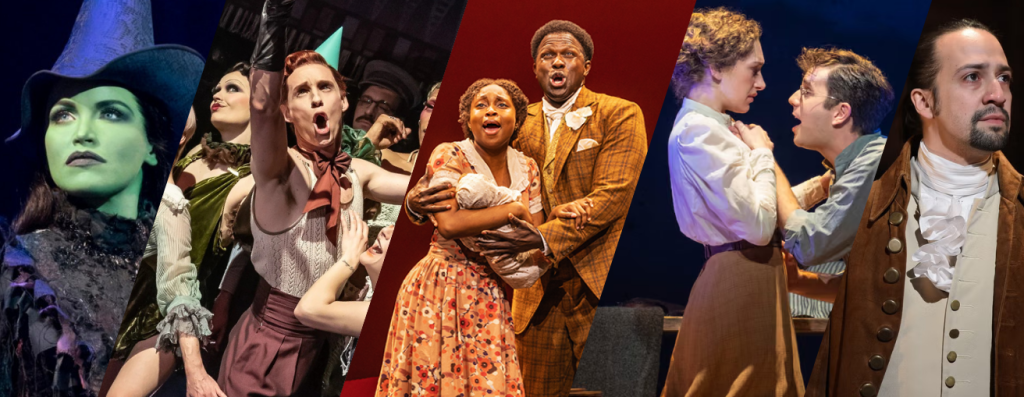
Header images L-R: Wicked (Joan Marcus), Cabaret (Marc Branner), Ragtime (Matthew Murphy), Parade (Joan Marcus), Hamilton (Theo Wargo)