EXXY and the Hidden Cost of Being Exceptional for Dan Daw
In EXXY, Dan Daw turns the cost of excellence into both a spectacle and a reckoning, exposing the hidden exertions behind a career shaped by queerness, disability and working class grit. Success arrives with applause, but it also arrives with fatigue, contradiction and the relentless pressure to adapt. Daw has always navigated those tensions, living a life where brilliance and self doubt coexist, where global touring sits beside the simple reality of not being able to butter their own bread. In this work, those contradictions move into the centre of the frame.
Sharing the stage with three performers whose bodies echo their own, Daw experiences something rare and profoundly liberating: reflection without distortion. The ensemble challenges inherited ideas of virtuosity by building choreography from the gestures they were once told to avoid, pushing their bodies to extremes in order to question why such extremes are demanded at all.
Across this conversation, Daw traces the origins of EXXY to a moment of visceral imposter syndrome in an industry meeting, the trust formed between collaborators with shared lived experience, and the childhood memories that still shape their present. The result is a work that confronts survival, celebrates embodiment and asks what might change, or stubbornly persist, for disabled artists in the decade ahead.
The title, EXXY, suggests cost, in money and in energy. When did you realise that success as a queer, disabled artist was not just an achievement but also something that was taking a hidden toll?
I think this is something I have always inherently known. Things have always been harder for me, but I just got on with it, because I didn’t like the alternatives if I simply gave up. Life has always been, and continues to be, full of dichotomies – I can be really brilliant at what I do, and still doubt myself every step of the way. I can work really hard and still have to carefully consider the prices on a menu whenever I go to a restaurant. I can tour the world and not be able to butter my own bread. In my life, two conflicting things often exist at the same time and this is possibly one of the reasons why life is sometimes so messy.
You share the stage with three performers who move like you, echoing and multiplying your presence. What is the most confronting thing about watching your own physicality reflected back at you, and what is the most liberating?
I wouldn’t say there has been anything confronting about finally seeing my own physicality reflected back at me. Making and touring the work have only been constant sources of liberation for me. It’s incredibly rare to pass another body on the street like mine, so it has been extremely profound spending time and sharing space with Tiiu, Sofia and Joe, because they make me want to be completely myself. This is why my grandmother is so pertinent to the EXXY narrative; the only other person in my life who allowed me to be completely myself was my nan.
Dance often fetishises virtuosity and “lines.” How do you frame virtuosity in your work so that it belongs to your body and your community, rather than to an inherited idea of perfection?
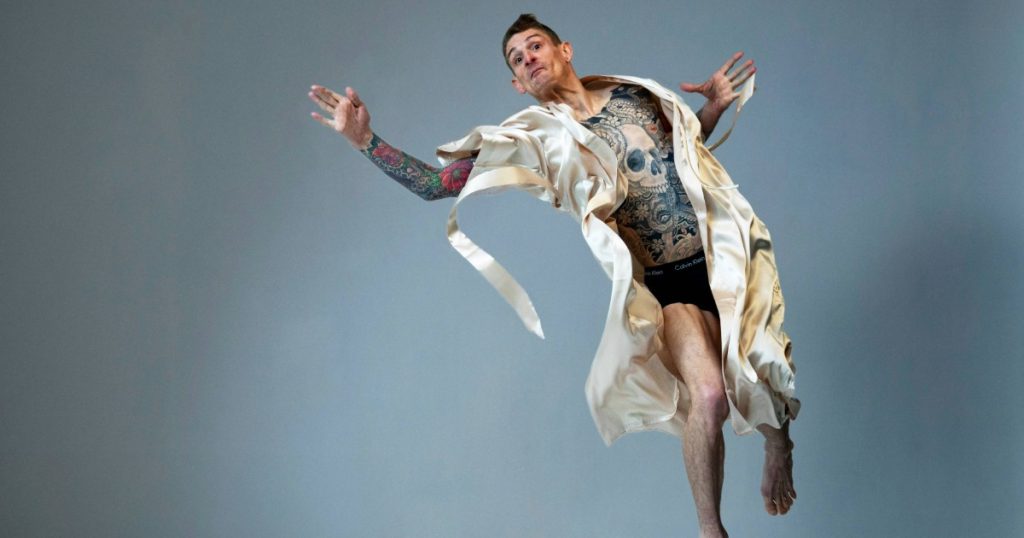
In the lead up to making EXXY, I spent so much time analysing my imposter syndrome and my fear of failure, that by the time we got into the rehearsal room, I wanted to work with the cast to isolate the things we were told never to do with our bodies and build them into choreographic scores. The choreography, at points, pushes our bodies to our absolute limits, and so, I guess it could be seen as virtuosic. This pulls into relief the bigger question EXXY is asking: “Why do we need to push ourselves to the verge of collapse before we feel like we’re doing enough?”
EXXY asks what it means to stay at the top of your game when you have always been on the outside. Have you ever caught yourself trying to “blend in” professionally in a way that betrayed what you actually wanted to make?
Ironically, I spent a good chunk of my career as a dancer at Candoco Dance Company trying to blend in and appear as non-disabled as I could. I think it’s actually the only job I’ve ever had where I’ve been made to feel like I couldn’t talk about having a different body. The turning point was when I worked with Javier de Frutos, in my last year with the company back in 2012, on a duet that centered the way I move by having my non-disabled partner adapt to my movement patterns and timings. During rehearsals I remember my dancing partner being livid that they had to adapt to me, and I remember thinking to myself: “Yeah, it’s hard isn’t it? To always be the one to adapt.” This process with Javier was revolutionary and transformed how I thought about myself both as a performer, and as a disabled man, living in the world.
The show reaches back into childhood while speaking directly from the present. When you were devising it, did you feel any responsibility to your younger self to tell the truth about what you have survived in the industry?
On the whole, the industry has been very good to me actually. I’m extremely proud of how far I’ve come and incredibly thankful to the people throughout the years who supported me along the way. EXXY is about how we survive and thrive in a capitalist, money-grabbing world and I don’t think, in my trajectory anyway, that I’ve thought about “surviving” in the industry, but I have spent a lot of my career thinking about the resilience of the industry itself and how it continues – or I would even say allowed – to survive, and occasionally thrive, within a system that simply doesn’t value it.
Working class background, disability and queerness all shape how your work is funded, marketed and received. Was there a specific industry meeting or note that crystallised for you how those systems see you, and did that moment feed into EXXY?
I was in a programming meeting looking for large-scale work by disabled choreographers to program in a dance festival we co-curated with Kampnagel, a performance venue in Hamburg. During our search, the curatorial team suggested that I make a work for big stages. Despite being on a Zoom call surrounded by people who believed in me tremendously, I remember feeling that I wasn’t ready to make a “big piece” and a massive wave of imposter syndrome and self-doubt swept over me. I was so intrigued at how visceral my response was, that I wanted to go before I felt ready by making the biggest piece of my career about the imposter syndrome I felt in that moment and at different points in my life. This is how EXXY was born.
Your collaborators in EXXY move like you, but they are not you. What kind of trust building did you need in the rehearsal room for them to take on parts of your lived experience without it becoming extraction?
We found there to be a sort of shorthand in the rehearsal room, because our experiences of our bodies, and how our bodies are perceived, were so similar. It was so rare for any of us to spend this amount of time with bodies like ours and I would say that trust developed very quickly and bonds were formed, paving the way for us to dig a little deeper into our stories and lived experiences that all helped to shape what the work became. We came to the shared realization that all four of us were able to celebrate our bodies, with beautiful moments, even on the first day, where we started to mock each other. It is this joy, underlined by our rage at being at the mercy of people in Governments who want everything for themselves and nothing for the world, that ended up being the foundation of the work.
If you imagine EXXY being performed in ten years’ time by another generation of disabled dancers, what do you hope will feel outdated about the pressures it describes, and what do you fear might still feel painfully accurate?
While I’m attracted to the poetry and romance of the landscape becoming gentler for disabled people in years to come, I’m afraid that I think we’d actually be able to present the work in its entirety a decade on, and it would all still be accurate. I don’t say this, because I’m a pessimist, but because I’m a realist. When kindness becomes our global currency, and we start working with each other rather than against each other, then I’ll happily put my hands up and say our work is outdated.
You have worked on major international stages and now you are back in a festival context that once helped build your profile. When you look at the current landscape for disabled dance artists in Australia, what is the bravest programming decision you wish a festival director would make next?
I’m not sure if there has ever been a disabled director of a major festival in Australia before, so it would be something quite incredible for festivals to expand their artistic leadership teams to include a Disabled Artist Associate. This is being done, to some extent, in Brisbane with Maddie Little and the Undercover Artists Festival, but would be revolutionary to see even more embedded models being implemented at major festivals right across the country.
EXXY is playing as part of Sydney Festival.
For more information and tickets CLIICK HERE