Virginia Gay Discusses the Ideas, People and Moments that Shaped MAMA DOES DERBY
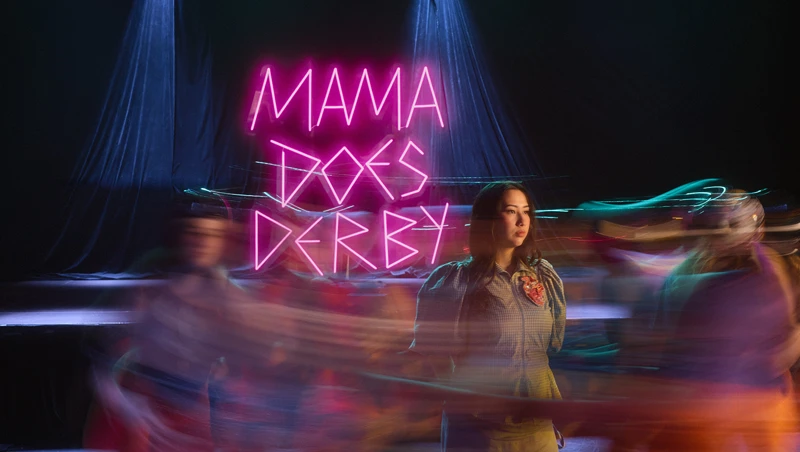
In MAMA DOES DERBY, the crackle of roller skates meets the emotional charge of a mother and daughter rebuilding their lives together. Created by Virginia Gay with director Clare Watson, the work is a high velocity mix of theatre, sport and gig energy, grounded in the intimate conversations that shaped its core. Speaking with real teenagers, including Clare’s own child Ivy, Gay encountered a generation carrying a sense of responsibility far heavier than rebellion. Their fears about the future, their frustration at being handed a burning planet and their resilience in the face of it all pulsed through the emerging story.
Equally influential was the vivid honesty of Clare and Ivy’s relationship, a bond that refuses neat labels. This dynamic of love, respect and tangled complexity became the emotional current that runs beneath the show. Layered onto that is the exhilarating culture of roller derby, with its grit, camaraderie and unapologetic individuality. Gay immersed herself in that world, absorbing its language, rhythm and fearless self expression.
The result is a work that celebrates strength, community and reinvention while holding space for vulnerability.
MAMA DOES DERBY is about a teenager and her mum rebuilding their lives. When you were developing the story, what conversations with real mothers, daughters or derby players most shifted how you understood that relationship?
We interviewed Clare’s actual kid, Ivy and Ivy’s partner, who were 19 when we first spoke to them and recent high school grads. And we talked to them about what it was like to feel like you had the weight of the world on your shoulders and the weight of saving the world on your shoulders. That was their presiding experience of teenage-hood. Not ‘let’s rebel! Let’s go out!’ It was, ‘what are we going to do with this burning planet?? And how are we expected to fix it?? You’re looking at us like we’re going to fix it…’
I also interviewed Clare extensively about her relationship with her child. Her dynamic as a mother, some might call “unconventional” but their relationship is so strong and is so filled with love and respect while also being tangled and beautiful. That was the energetic modelling that I was doing. So, lots and lots of chatting to Clare and Ivy. Then just spending as much time as possible with derby players as I could. Just being around derby players and listening to the way they spoke to each other. And just feeling the camaraderie and the shorthand and the brusk-ness and the fearlessness in the way that they engaged. I knew that was going to be very valuable for us.
Roller derby is full of reinvention, people choosing a new name and persona when they strap on skates. Did that idea of self-rebranding change how you think about your own identity as an artist and as a person?
Well, I would say that roller derby doesn’t necessarily ask you to change yourself or to put on a mask. I think it reveals the most exciting qualities about yourself and puts them centre stage. It’s about finding exactly what it is that makes you exceptional and totally and uniquely yourself – and then turning up the volume on that.
That’s what you do when you make characters too. When you write characters, you’re trying to find what makes them interesting and exceptional and charismatic and magnetic and then turning up the volume on that to make sure that they’re all they’re always saying what is true to them in the most succinct and dynamic and impactful ways.
We love the aesthetic of derby too, that ‘DIY spectacular’ aesthetic. Cheap, lame and incredible opp-shops finds held together by a bit of duct tape and a can do attitude. ‘Doesn’t this look spectacular when it’s in movement? Doesn’t it do everything we need it to do and it’s only 20 bucks for the Spotlight?’ I love that aesthetic.
The show sits somewhere between theatre, sport and live music gig. In rehearsal, what did you find yourself fighting hardest to protect from each form, and what did you happily sacrifice in order to make the hybrid work?
When all of all of Australia, but particularly young girls in Australia, went apeshit when the Matildas made it to the World Cup – we saw what that did to the audience experience. Suddenly people who were previously all ‘ugh sport’ were now screaming “I know everything about this sport!”, “I know everything about Sam Kerr, everything about McKenzie!”. I was in a pub in Scotland watching the qualifying game. The whole place was packed and we were screaming and crying and holding each other. So we wanted to borrow that from sport and see how much of that we could bring into a theatrical space.
I think every piece of theatre is better with live music in it. Like, I truly, truly believe this. And when you have multi-talented people too, who can jump in and out of roles – making music and then playing roles too – I think that’s so impressive and it’s such a joy to watch.
With any live performance, in any form, there’s something exhilarating about being an anonymous audience member in one space with a huge bunch of strangers experiencing something together. It’s different to experiencing it at home on a screen. You can’t clock out in the same way. You suddenly find yourself surrounded by people who are all feeling the same things as you, simultaneously. And that is so intoxicating. And irreplicable.
We’re borrowing from each form and seeing where we could bleed the lines between forms. I don’t think it’s a competition. It’s how can each genre can inform and help strengthen the other.
Motherhood is often portrayed as either saintly or disastrous. How did you and Clare Watson work to find the messy middle ground, where a mother can be loving, flawed, petty and heroic in the same scene?
It’s the crazy idea that mothers are, and stick with me here, whole people who are flawed and complicated and contain multitudes. They are not a role, they are not one thing. They are complex and complicated. Whole human beings with conflicting responsibilities and hopes and dreams. Craaaaazy, I know.
We were clear from the beginning that we wanted this to be a show with two leads, our mother and daughter are equal leads, that their stories were of equal importance. And while the primary lens that we view things is through our teen character, Billie, it was such a joy to write Maxine, because she’s one of our two heroes. And she shows why she’s Billie’s hero too.
I have a lot of friends who are cool mums, who are the funniest, darkest, big hearted-est, complicated, sometimes lonely, sometimes deeply romantic, sometimes cynical, full human creatures. And I wanted to honour them and give Maxine as many funny, complicated, confused, but also instinct-driven lines as possible.
Roller derby culture has a strong queer, feminist and grassroots energy. Which parts of that culture did you most want to preserve onstage, and which parts did you deliberately reshape for a broader festival audience?
Every single part of it. The queerness, the feminism, the grassroots energy. I would also say we were really attracted to the impact of the sport – the full body contact, the strength and resilience required to play – it is so impressive. We loved the community nature of it, the sense of the team. The idea that we are stronger together than we are apart. We haven’t reshaped anything. We’ve just tried to draw more eyes to the very qualities that make roller derby so exciting.
When a teenager walks out of Sydney Town Hall after seeing this show, what conversation do you secretly hope they will start with the person who brought them?
I would love them to feel that they could talk about their heart and their mind. That they might be able to have a conversation about their fears. And they might find some words that can shape their fears which might not have been available to them before.
I would hope, too, that they would feel less alone in the experience of being a teenager, which is pretty isolating as I recall… it’s been a couple of years. But, I mean, the words feel fresh, which is indicative, isn’t it? If I can think teenager and immediately go “ugh, my God, that feeling.” Imagine if you could also give something to people who were feeling that and say it’s not just you. We all feel like this!
Maybe that they could know that they could have those conversations and be a bit flawed and a bit broken and still be deeply loved by the person that brought them to the show. Because hopefully the show has shown them that we can have secrets and we can make mistakes and we can misunderstand people. But if there is love through everything, you’ll find a way back to each other.
MAMA DOES DERBY is playing as part of Sydney Festival
For more information and tickets CLICK HERE