
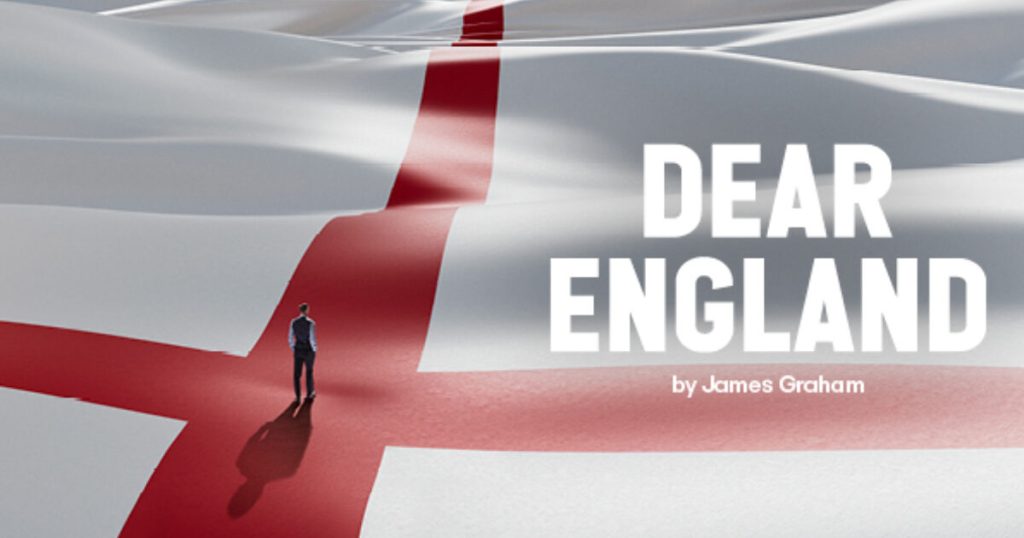
DEAR ENGLAND Tours the Nation with Football and Theatre in Perfect Harmony
We’ve all heard cautionary tales of sports-based plays that end up merely comedic or clichéd. DEAR ENGLAND is the antithesis. Fresh off an Olivier Award, it delves into Gareth Southgate’s multi-year project to transform the national squad, shining a spotlight on the psychological and emotional revamp that many credit for England’s renewed fighting spirit on the pitch. James Graham’s script premiered at the National Theatre in the summer of 2023, then stormed the West End with a flurry of rave reviews before returning to the National for another run.
It’s now set to tour the country this autumn (and beyond), giving audiences from Plymouth to Birmingham a chance to experience a performance that’s part sports drama, part soul-searching odyssey. It also happens to coincide with the works of a certain new wave of British theatre that celebrates everyday heroes—people outside of the usual Shakespearean ranks, if you will. In DEAR ENGLAND, the “courtly intrigue” is replaced by World Cup anxieties and penalty shootout flashbacks, the comedic relief by locker-room banter. Yet, it resonates with all the tension and triumph you’d expect from a classical theatre piece.
A Creative Powerhouse Behind The Scenes
When you discover that Rupert Goold is directing, the pieces start falling into place. He’s garnered accolades for injecting fresh energy into classics like Macbeth and new works like Ink. Under his helm, DEAR ENGLAND thrives as a dynamic production: it’s unafraid to break the fourth wall or suspend realism if it serves to intensify the narrative. That sense of creative fearlessness extends to the rest of the team too. For example, set designer Es Devlin is renowned for her ability to construct immersive worlds—she’s collaborated with superstars from Beyoncé to Adele. If she can craft ethereal landscapes for stadium shows, imagine what she’s conjuring for a piece that straddles the line between theatrical stagecraft and the raw excitement of a live match.
The rest of the creative roster is equally impressive. Costume designer Evie Gurney keeps the looks authentic but not purely athletic, while lighting designer Jon Clark manipulates the stage so that each penalty shootout or manager’s pep talk bristles with cinematic energy. Meanwhile, the co-movement directors Ellen Kane and Hannes Langolf bring an almost balletic approach to the show’s physicality. Footballers rarely move in a simplistic, uniform manner—they lunge, pivot, sprint—so capturing that dynamism on stage is a challenge. Evidently, the teamwork behind the scenes is as integral to the production as the synergy on any football pitch.
A National Celebration
It’s rare for a theatre piece centred on such a distinctively English subject to embark on a tour quite this expansive. But as James Graham himself put it, the idea is to take it “beyond the capital” so that communities across the nation—particularly those with fewer cultural resources—can experience the show’s signature blend of spectacle and introspection.
The tour officially kicks off at Plymouth Theatre Royal on 15 September before continuing to Nottingham Theatre Royal (23–27 September), Marlowe, Canterbury (7–18 October), Sheffield Lyceum (21–25 October), and Leeds Grand Theatre (4–8 November). Then it charges on to Theatre Royal Newcastle (11–15 November) and Chichester Festival Theatre (20–29 November). After a brief hiatus, it resumes in 2026 at Mayflower Theatre Southampton (13–17 January), Milton Keynes Theatre (20–24 January), New Theatre Oxford (27–31 January), Norwich Theatre Royal (3–7 February), New Victoria Theatre Woking (10–14 February), Alhambra Theatre Bradford (17–21 February), New Wimbledon Theatre (24–28 February), Liverpool Empire (3–7 March), and finally Birmingham Hippodrome (10–14 March).
Tour schedules can often feel like a logistical nightmare—transporting sets, coordinating lodging, ensuring each local venue meets technical requirements. Yet, these journeys also generate buzz in smaller cities where theatre enthusiasts might otherwise only catch the big hits via train rides to London. A recent survey by the UK’s National Campaign for the Arts revealed that 38% of regular theatre-goers who live outside major cities are more likely to see a show if it tours to a regional venue. The wide reach of DEAR ENGLAND, then, could be the impetus for a new wave of theatre-lovers who discover it in their own backyard.
Psychology And Poetry
You may assume that a play about football would revolve around match highlights or comedic caricatures of referees. But DEAR ENGLAND does something rather profound: it zeroes in on how Gareth Southgate reinvented the psychological approach to managing an underperforming team riddled with past failures. In many ways, it’s a study of leadership, vulnerability, and forging unity in the face of overwhelming scrutiny.
One angle that often surprises audiences is the poetry woven into the text. James Graham has a knack for infusing dialogue with a subtle lyrical quality. While it’s not verse drama by any means, you’ll catch lines that linger in your mind long after the final curtain. The emotional tapestry is complemented by additional music composed by Max Perryment, who never allows the soundtrack to overshadow the dialogue but instead uses subtle motifs to underscore key emotional beats. That synergy might catch you off guard, especially if you stroll in expecting a raucous comedic take on footie culture. Instead, you’ll find a layered theatrical experience where heartbreak and hope seamlessly collide.
From Stage To Screen
An exciting development for fans is the confirmation of a forthcoming TV adaptation. While stage and screen versions can sometimes differ in tone (due to the inherent intimacy of live performance), there’s genuine curiosity around how DEAR ENGLAND will translate to the small screen. Will it preserve the direct audience address? Will the immersive set design be reimagined for a more naturalistic backdrop? Although no release date has been announced, theatre buffs are already speculating on casting choices. After all, many fans might relish the opportunity to see their favourite stage performer tackle the role of Gareth Southgate or Harry Kane in a filmed format.
Not every theatre piece transitions well to screen (ask any purist about the pitfalls of certain musical film adaptations). But given James Graham’s track record for penning punchy, timely scripts that adapt seamlessly (he’s written for TV before), the prospects seem bright. And for those who can’t make the live show, the TV version might serve as a gateway into the world of DEAR ENGLAND. Who knows, it could also nudge a whole new demographic of sports fans into exploring theatre.
A Moment of Community
In a time when we’re often divided along lines of politics, geography, or even sporting alliances, it’s heartening that a single production can unite us in shared wonder. DEAR ENGLAND isn’t just about celebrating one football manager’s ingenuity or reliving the highs and lows of the Three Lions’ journey. It’s a testament to the power of theatre to reflect our collective anxieties and aspirations—especially around issues like national identity and the weight of historical baggage. The story’s universal themes—resilience, leadership, the push to redefine a legacy—could resonate with anyone who’s ever felt the sting of defeat or the thrill of a renewed chance.
Behind the curtain, the production’s creative team fosters this communal spirit. The synergy between set, sound, light, and physicality is meticulously crafted, and yet, there’s an underlying humility. They aren’t trying to overshadow the story; they’re drawing us deeper into it. By the time you exit the theatre, there’s a palpable sense that you’ve witnessed not just a performance, but a conversation—one that might continue in the pub afterwards or on the car ride home.
Final Whistle, Lasting Echo
So often, we see theatre and football as cultures apart—one steeped in velvet seats and dramatic soliloquies, the other in roaring crowds and half-time pies. DEAR ENGLAND gracefully bridges that chasm, reminding us that art and sport can share a common stage if approached with authenticity and heart. Whether you’re the type who bleeds theatre or the type who paints your face for every tournament, this production offers you something enthralling.
From its autumn debut in Plymouth to its final matches in Birmingham next spring, DEAR ENGLAND is poised to make an unforgettable impact on audiences across the nation. The fact that it’s already spawned a TV adaptation and garnered an Olivier Award testifies to its significance. But what truly matters is the realisation that both theatre and football can stir our emotions, evoke our loyalties, and spotlight our collective yearnings for victory—on stage, on the pitch, and in life. If that isn’t worth cheering for, I don’t know what is.